

A garage door that opens halfway and stops is almost always caused by one of six mechanical or sensor-related issues: miscalibrated travel limit settings, misaligned safety sensors, a broken or weakened torsion spring, a slipped or frayed cable, worn rollers or a track obstruction, or a failing opener motor or drive gear. This is a frustrating problem for Bedford, TX homeowners because it cuts off access to your garage without warning and rarely fixes itself. Understanding what is behind the mid-travel stop helps you determine whether a quick DIY check will solve it or whether professional garage door repair is needed before the problem gets worse. This post walks you through every likely cause, what to look for, and exactly where the DIY line sits.
What It Means When Your Garage Door Stops Midway in Bedford, TX
When a garage door stalls partway through its travel, it is not random. The door stopped at that point for a specific reason tied to the mechanical system, the opener, or the safety hardware. In most cases, the opener detected a condition that told it to halt. That condition could be a sensor signal, a resistance threshold, a limit boundary, or a mechanical failure preventing smooth movement. The door is doing exactly what it was programmed to do. The problem is that what triggered the stop needs to be identified before any fix is possible.
Is This a Safety Issue or a Mechanical Problem?
In many cases, it is both. Safety sensor faults and spring failures are among the most common triggers for a mid-travel stop, and both carry real risk if handled incorrectly. A misaligned sensor is a relatively low-stakes fix for most homeowners. A broken torsion spring is not. Before assuming this is a minor nuisance, it is worth pausing and observing the door carefully before touching anything.
How Common Is This Problem for Bedford, TX Homeowners?
This is one of the more frequent service calls in the Bedford and mid-cities area of the DFW metroplex. North Texas weather puts consistent stress on garage door hardware. Summer heat expands metal components and can throw travel limits off. Temperature swings between seasons affect spring tension. Dust and debris from the region’s dry, windy conditions settle on sensor lenses and roller tracks. Bedford homeowners often notice these problems surfacing in late spring and early fall when the temperature shifts are most dramatic.
Why Ignoring a Mid-Travel Stop Can Make Things Worse
A garage door that stops at the halfway point and is then forced open or closed manually is a door that is about to cause a larger problem. Forcing a door past a mechanical resistance point can snap a cable, bend a track, or strip the opener’s drive gear. If the root cause is a weakening spring, continued use accelerates the failure point. What starts as an inconvenient half-stop can become a door that will not move at all, or worse, one that drops unexpectedly.
The Most Common Reasons a Garage Door Opens Halfway and Stops
There are six primary causes behind this problem. Each one produces slightly different symptoms. Knowing how to read those symptoms points you toward the right diagnosis before any tools come out.
Travel Limit Settings Are Out of Calibration
Every garage door opener has travel limit settings that tell the motor how far to move the door in both the open and close direction. When those settings drift or are set incorrectly, the opener stops the door before it completes its full travel. This is especially common after a power surge, after a new opener is installed, or after the door has been manually overridden multiple times.
How to Tell If Your Opener Limit Switch Needs Adjusting
The clearest sign of a limit issue is that the door stops at the same point every single time, without any grinding, straining, or sensor blinking. The opener sounds like it finishes its cycle normally, but the door simply does not reach the top or bottom. On most openers, the limit adjustment screws are located on the side or back of the motor unit and are labeled “UP” and “DOWN.” Consult your opener’s manual before touching these, as the adjustment range varies by model.
Safety Sensors Are Blocked, Dirty, or Misaligned
The two small sensors mounted near the bottom of your garage door tracks send an invisible beam across the door opening. If that beam is broken or obstructed during operation, the opener interprets it as an object in the path of the door and stops travel immediately. This is a deliberate safety function, not a malfunction. The problem is that sensors can be triggered by dust buildup on the lens, a spider web, direct sunlight hitting the sensor eye, or a sensor bracket that has been bumped out of alignment, resulting in what technicians call a Safety Sensor Out of Adjustment.
The Quick Bedford Homeowner Sensor Check
Look at both sensor units at the base of your tracks. The sending sensor typically has a steady amber light. The receiving sensor typically has a steady green light. If either light is blinking or off, the beam is not aligned or is being blocked. Wipe both lenses with a dry cloth. Check that both brackets are pointed directly at each other. If the green light returns and holds steady, the sensor was the problem. If it continues to blink, the bracket may need to be repositioned.
A Torsion Spring Is Losing Tension or Has Broken
The torsion spring mounted horizontally above your garage door is what does the actual lifting work. The opener provides the motion; the spring provides the counterbalance force. When a spring loses tension over time or breaks entirely, the door becomes too heavy for the opener to lift fully. The motor strains against the resistance, triggers its overload protection, and stops the door mid-travel to prevent burning out.
Why Spring Tension Directly Controls How Far Your Door Travels
A properly tensioned spring should make the door feel nearly weightless when lifted manually. Disconnect the opener and try lifting the door by hand from the closed position. If it feels very heavy, requires significant effort, or will not stay in place when you let go at the halfway point, the spring system is the likely cause. A door that drifts down on its own at mid-travel is a strong indicator of a Broken Garage Door Spring. Do not continue using the door in this condition.
A Cable Has Slipped or Become Frayed
The lift cables run along both sides of your door, connecting the bottom corners of the door to the spring drum at the top of the track. If one cable slips off its drum or develops a fray, the door loses balanced support on one side. This creates uneven tension, causes the door to bind in the tracks, and triggers the opener’s resistance sensor to halt movement.
What to Look For on Both Sides of the Door
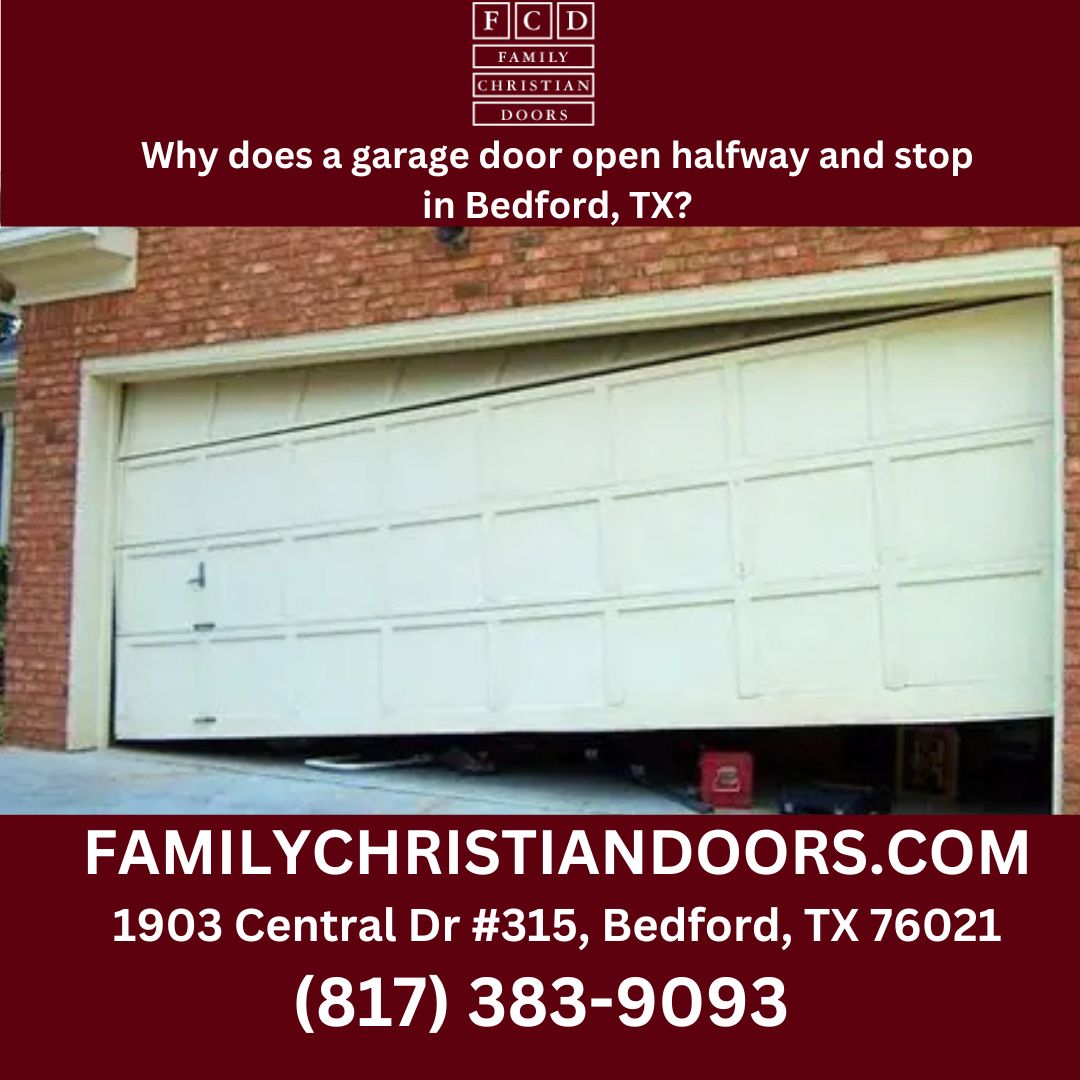
With the door in the closed position, visually inspect the cables running vertically along the inside of each track. Look for any slack, looping, fraying, or a Cable off Garage Door drum at the top. A cable issue often shows itself as a door that sits slightly crooked or tilts to one side. Do not attempt to reattach or tension a cable manually. Cable tension is directly tied to spring tension, and adjusting it without proper tools creates a serious injury risk.
Worn Rollers or a Track Obstruction Are Causing Resistance
Rollers are the small wheels that guide the door panels along the vertical and curved sections of your track. When rollers wear out, crack, or lose their bearings, they create friction instead of smooth rolling movement. That friction registers as resistance in the opener, which then stops the door to avoid forcing it further. Track obstructions, including dents, debris buildup, or a section of track that has shifted out of plumb, produce the same result.
Roller and Track Problems Common in North Texas Weather Conditions
In the Bedford area, plastic rollers are particularly vulnerable to the summer heat. High temperatures cause the nylon to expand and, over time, to deform slightly, which increases friction in the track channel. Steel rollers with sealed ball bearings hold up better in Texas conditions but still require periodic lubrication. If you hear grinding, squeaking, or feel resistance when manually moving the door, a roller or track issue is a strong candidate.
The Opener Motor or Drive Gear Is Failing
Inside your garage door opener, a drive gear meshes with the main gear to transfer motor power to the trolley that pulls the door. When that drive gear wears down, the gear teeth strip and the motor runs without transferring full power to the door. The door may start moving and then stall as the stripped gear slips under load.
Signs the Opener Itself Is the Problem
If you hear the motor running but the door barely moves or moves in short, stuttered bursts before stopping, the drive gear or motor capacitor is likely failing. A burning or plastic smell from the opener unit during operation is another indicator. Unlike sensor or limit issues, a failing drive gear requires internal repair of the opener itself, which is not a straightforward homeowner task.
What a Garage Door Technician Checks First in Bedford, TX
An experienced technician does not guess at the cause of a mid-travel stop. The diagnostic process follows a specific order that moves from the simplest and safest checks to the more complex mechanical inspections. Skipping steps or jumping straight to spring adjustments without ruling out sensor and limit issues first is how misdiagnoses happen.
How North Texas Heat and Humidity Affect Spring Tension and Sensors
Bedford sits in a climate zone where summer temperatures regularly exceed 100 degrees Fahrenheit and humidity swings are significant. Metal springs expand and contract with temperature changes, which affects calibrated tension over time. Sensor lenses accumulate grime faster in dusty, windy conditions common across Tarrant County. These regional factors mean that some causes of mid-travel stops are statistically more common in this area than in cooler or more temperate climates.
The Diagnostic Order a Professional Follows
A thorough inspection starts with the sensors and limit settings because those are the quickest to check and the most frequently at fault. From there, the technician manually tests door balance to assess the spring system. Cable condition is evaluated visually and by feel. Roller and track condition are checked along the full length of both tracks. The opener internals are tested last, since they are the least accessible and require the other components to be ruled out first.
Mid-Travel Stop by Cause: A Quick Reference Guide
| Symptom Observed | Most Likely Cause |
|---|---|
| Door stops at the exact same point every cycle | Travel limit setting miscalibration |
| Door stops and opener light flashes repeatedly | Safety sensor misalignment or obstruction |
| Door stops and will not budge manually | Broken torsion spring or cable failure |
| Door grinds or strains noticeably before stopping | Worn rollers or track obstruction |
| Motor runs but door barely moves or stutters | Drive gear wear or motor capacitor failure |
What Bedford Homeowners Can Safely Check Before Calling a Technician
Not every mid-travel stop requires an immediate service call. There are three safe checks any homeowner can perform without tools and without risk of injury. These steps should be completed in order before anything else is attempted.
Three Safe Steps Any Homeowner Can Try First
Step 1: Clear and Realign the Safety Sensors
Start at the sensor units near the base of each track. Remove any debris, cobwebs, or dirt from the lens with a dry cloth. Check that both sensors are pointed directly at each other and that no object is sitting in the path of the beam. Verify that the indicator lights match what your opener manual specifies for aligned operation. If the green receiving light returns to a steady state after cleaning or adjusting, attempt to cycle the door again.
Step 2: Check the Travel Limit Settings on Your Opener
If the door stops at the same point on every cycle and the sensors check out, locate the limit adjustment on your opener unit. Most models have small adjustment screws or a digital programming button sequence. Refer to your opener manual for the exact method for your brand and model. Make small adjustments, test the door after each change, and do not exceed the adjustment range specified for your unit.
Step 3: Manually Test the Door for Balance and Resistance
Pull the red emergency release cord to disconnect the opener. Lift the door by hand from the closed position to waist height, then let go. A properly balanced door should hold at that position without moving. If the door drops back down, the spring tension is insufficient. If it feels very heavy to lift, the spring or cable system is not providing adequate counterbalance. In either case, stop manual operation and contact a technician.
When the Problem Requires a Licensed Technician in Bedford, TX
If the three checks above do not resolve the issue, or if the manual balance test reveals a heavy door or one that will not hold position, the problem is beyond a homeowner fix. Sensor adjustments and limit calibrations are reasonable DIY territory. Spring tension, cable reattachment, Garage Door Roller Repair, and opener internal repairs are not. Attempting those without training and the correct tools results in injury risk and, in most cases, a larger repair bill than the original problem would have generated.
Why Spring and Cable Repairs Are Not DIY-Safe
A standard residential torsion spring stores a significant amount of mechanical energy. When it releases uncontrolled, the result is dangerous. Professionals use winding bars, tension gauges, and follow a specific sequence to adjust or replace springs safely. Similarly, cable tension is calibrated against the spring system. Adjusting one without accounting for the other throws the entire counterbalance out of spec and stresses the opener unnecessarily. These are not tasks where watching a video tutorial provides adequate preparation.
Get Your Garage Door Moving Smoothly Again in Bedford, TX
If you have worked through the safe homeowner checks and the door is still stopping mid-travel, or if the balance test indicated a spring or cable issue, the next step is a professional inspection. Waiting on a spring or cable problem does not make it better. It makes it more expensive and more likely to fail completely at an inconvenient time, often leaving a vehicle trapped inside or outside the garage.
What to Expect When You Call Family Christian Doors
A technician from Family Christian Doors will perform a complete inspection of the full system, not just the part that appears to be failing. The diagnostic process covers sensors, limit settings, spring condition, cable integrity, roller and track condition, and opener hardware. You will receive a clear explanation of what caused the mid-travel stop and what the repair involves before any work begins. There is no guesswork and no pressure to approve repairs that are not necessary.
Schedule a Same-Day Inspection in Bedford, TX
Family Christian Doors serves Bedford and the surrounding mid-cities area with same-day and next-day availability for most garage door issues. Whether the cause turns out to be a simple sensor alignment or a full spring replacement, the goal is the same: a door that opens and closes completely, every time, without hesitation.
Conclusion
A garage door that opens halfway and stops in Bedford, TX is a solvable problem in every case. The cause is always one of six things: a travel limit out of calibration, a sensor fault, a spring or cable failure, worn rollers, a track obstruction, or a failing opener component. Bedford homeowners can safely check sensors, limits, and door balance on their own. Anything involving the spring, cable, roller replacement, or opener internals belongs in the hands of a trained technician.
Family Christian Doors has been diagnosing and repairing these exact problems for homeowners throughout Bedford and the greater DFW area. If your door is stopping mid-travel and the safe homeowner checks have not resolved it, reach out to the team at Family Christian Doors. Visit familychristiandoors.com/garage-door-repair-bedford/ to learn more about the services available in your area or to schedule an inspection today.