

A garage door that reverses before fully closing is most often caused by misaligned safety sensors, incorrect limit switch settings, physical obstructions in the track, worn rollers, or a misconfigured auto-reverse sensitivity on the opener. Each of these issues interrupts the door’s closing cycle and sends it back upward as a protective response. For Flower Mound homeowners, this is one of the most common garage door repair service calls we receive, and while some causes have simple fixes, others signal deeper mechanical problems that deserve a professional’s attention. Understanding the difference between the two can save you time, frustration, and prevent a minor issue from becoming a costly repair.
Why Your Garage Door Reverses Before Closing: Understanding the Safety System
How the Reversal Mechanism Is Designed to Protect You
Modern garage doors are not designed to close unconditionally. Federal safety regulations require all residential garage door openers manufactured after 1993 to include an auto-reverse feature. This system monitors resistance during the door’s travel. The moment the opener detects an unexpected force or an interrupted signal, it immediately reverses the door’s direction.
Think of it like a circuit breaker in your home’s electrical panel. The breaker does not know the difference between a dangerous short and a temporary overload. It simply responds to a signal that tells it something is wrong. Your garage door opener works the same way. When it receives an unexpected input, it stops and reverses to protect whatever or whoever may be in the door’s path.
This safety feature is genuinely important. It protects children, pets, and vehicles from being struck by a closing door. The problem arises when the system triggers a reversal in response to a false signal, a misalignment, or a worn component rather than an actual obstruction.
When Reversal Becomes a Problem vs. Working as Intended
If your door reverses after making contact with an actual object in its path, the system is doing exactly what it should. However, if the door consistently reverses without any visible obstruction, or if it reverses just before reaching the ground, that is a clear sign that something within the system needs to be diagnosed and corrected. Left unaddressed, the underlying cause will often worsen over time.
Safety Sensors Out of Alignment: The Most Common Culprit
How Photo-Eye Sensors Work on Your Garage Door
Two small photo-eye sensors sit mounted near the base of your garage door tracks, one on each side, approximately four to six inches above the floor. One sensor sends an invisible infrared beam across the width of the opening, and the other receives it. As long as that beam remains unbroken, the door is permitted to close. The moment something interrupts the beam, the opener interprets that as an obstruction and reverses.
This design works well when the sensors are properly aligned and free of interference. When they drift out of alignment, even slightly, the receiving sensor never fully detects the beam. The opener then treats every closing attempt as if something is blocking the door, triggering a reversal each time.
Signs Your Safety Sensors Are Misaligned in Flower Mound Homes
The most visible sign of a sensor problem is a small indicator light on one or both sensors. Most opener brands use a steady green light to indicate proper alignment and a blinking amber or red light to signal misalignment. Other signs include:
- The door closes reliably when you hold the wall button down but reverses when using the remote
- The door reverses immediately after starting its downward travel
- The opener light blinks a specific number of times after a reversal, which is a diagnostic code pointing to sensor issues
- Cobwebs, dust, or direct sunlight on the sensor lens interfering with the beam
In Flower Mound and the broader North Texas area, seasonal factors play a role here. High afternoon sun in summer can flood a west-facing garage opening and temporarily overwhelm a sensor’s ability to detect the beam, causing intermittent reversals that seem random but follow a predictable pattern based on time of day. When standard cleaning and realignment do not resolve the issue, a Safety Sensor Out of Adjustment service call is the appropriate next step.
Can You Fix Misaligned Sensors Yourself?
DIY Sensor Check: What to Look For
Start by wiping both sensor lenses clean with a soft, dry cloth. Next, check that both sensors are securely mounted to their brackets and pointing directly at each other. Gently reposition a sensor that appears to have rotated or drooped, then observe the indicator lights. If both lights return to a steady state and the door closes normally, a simple realignment solved the issue.
Also inspect the wiring running from each sensor back to the opener motor unit. Look for frayed insulation, pinch points where a vehicle may have rolled over the wire, or loose connections at the terminals.
When Sensor Problems Require a Professional
If both sensors appear properly aligned and clean but the blinking light persists, the sensor itself may have failed internally. Sensor replacement is a straightforward job for a trained technician, but attempting to replace sensors without matching the correct model to your opener brand can create compatibility issues. A technician will also test the complete circuit rather than addressing only the visible component.
Incorrect Limit Switch Settings Causing Premature Reversal
What a Limit Switch Does and Why It Matters
A limit switch tells your garage door opener exactly how far the door should travel in each direction before stopping. Every opener has two limit settings: one for the fully open position and one for the fully closed position. These settings are calibrated so that the door rests firmly on the ground when fully closed, compressing the weather seal evenly across the bottom of the opening.
When the down-limit is set incorrectly, the opener believes the door has reached the floor before it actually has, or it believes the door is being forced past the intended stopping point. In either case, the opener interprets this as resistance and reverses.
How to Tell If Your Limit Switch Is the Problem
The clearest sign of a limit switch issue is a door that consistently reverses at the same point in its travel, usually just before it reaches the closed position, with no object in the way and no blinking sensor lights. The reversal happens at a predictable height, often two to four inches above the ground.
Down-Limit vs. Up-Limit: Which Setting Controls Closing?
For a door reversing before it fully closes, the down-limit setting is the one to examine. The up-limit setting controls how far the door opens and would only be relevant if the door were reversing on its way up. Most belt-drive and chain-drive openers have manual limit adjustment dials or screws accessible through a small panel on the motor unit. Screw-drive and smart openers may require adjustment through a remote programming sequence or a connected app.
Adjusting Limit Switches: DIY vs. Professional Assessment
Older openers with manual dials are often adjustable by a confident homeowner using the manufacturer’s instructions. However, over-adjusting the down-limit can cause the door to exert excessive downward force on the closed position, placing stress on the springs, cables, and the door bottom itself. If the limit adjustment requires more than a small correction, or if the issue returns shortly after adjustment, a professional should inspect the full system to rule out underlying mechanical causes.
Track Obstructions and Physical Blockages
Common Objects and Debris That Trigger Reversal
The garage environment accumulates debris in ways that are easy to overlook. Leaves, gravel, small tools, and even dried mud can collect inside the track channel or along the floor where the door seals. Any object that interrupts the door’s path or resists its downward pressure will trigger the auto-reverse feature.
Walk the full length of both tracks from floor to ceiling before assuming the problem is electrical or mechanical. Clear anything resting against the track walls, in the track channel, or on the garage floor directly beneath the door.
Track Damage That Mimics an Obstruction Signal
Bent Tracks and How They Cause False Reversals
A bent or dented section of track does not have to be dramatic to cause problems. Even a modest deformation of the vertical track near the floor can create enough drag on the rollers to register as resistance. The opener senses that it is working harder than expected and interprets that added effort as an obstruction, reversing the door before any actual blockage is present.
Bent tracks are a common result of vehicles clipping the lower track section during entry or exit, particularly in homes with narrow garage openings or tight turning radiuses. If a track has been bent and straightened multiple times, the metal fatigues and weakens. At that stage, track replacement is the more reliable solution.
Inspecting Your Track System in North Texas Conditions
In North Texas, temperature swings between summer and winter place cyclical stress on the metal components of a garage door system. Tracks can develop small warps over multiple heating and cooling seasons. Inspecting the tracks twice a year, particularly in spring before summer heat and in fall before winter cold, allows you to catch developing problems early. Look for gaps between the track and the wall mounting brackets, sections that appear bowed inward or outward, and roller wear marks that suggest the door is dragging through a specific zone.
Worn or Damaged Garage Door Rollers Affecting Travel
How Roller Friction Creates Resistance That Triggers Reversal
Rollers are the small wheels that carry the door through the track as it opens and closes. Standard nylon or steel rollers have a finite service life. As the bearings wear and the roller body degrades, the door encounters increasing friction through its travel. The opener compensates up to a point, but when friction exceeds the system’s built-in resistance threshold, it responds as if the door has hit an object and reverses.
This type of reversal often develops gradually. The door may begin closing more slowly than it used to, or the opener motor may sound strained during the closing cycle before a reversal finally occurs.
Identifying Worn Rollers Before They Cause Bigger Problems
A visual inspection will reveal rollers that are cracked, chipped, or wobbling on their stems. Listen for grinding, squealing, or a rhythmic clicking sound as the door moves, each of which points to roller wear. Nylon rollers with sealed bearings typically last between seven and ten years under normal use. Steel rollers may last longer but generate more noise as they wear and can damage tracks over time if not replaced. Addressing worn rollers early prevents the compounding wear on tracks and hinges that follows when a door travels on degraded rollers for extended periods. A professional Garage Door Roller Repair can restore smooth, quiet operation before the problem advances to the track or hinge hardware.
Garage Door Opener Logic Board and Sensitivity Settings
Auto-Reverse Sensitivity: Set Too High vs. Too Low
Garage door openers include a force or sensitivity adjustment that determines how much resistance the motor will tolerate before triggering a reversal. This setting is expressed differently across brands, as a dial, a numbered setting, or a pressure threshold, but the principle is consistent across all of them.
When sensitivity is set too high, meaning the opener is highly sensitive to even small amounts of resistance, the door reverses in response to minor friction that does not represent any real danger. Seasonal temperature changes are a common trigger here. Cold weather causes metal components to contract and lubricants to thicken, increasing the resistance the door meets during travel. An opener with overly sensitive settings may reverse consistently during winter months but close normally in warmer seasons.
When sensitivity is set too low, the door may push through resistance rather than reversing when it should, which is a safety concern. Proper calibration requires balancing responsiveness with safety, and the manufacturer’s testing procedure, typically involving a two-by-four board placed flat on the floor under the door, should be followed when adjusting this setting.
When a Failing Logic Board Sends False Reversal Signals
The logic board is the control center of your garage door opener. It processes input from the sensors, the limit switches, the force settings, and the remote signals, coordinating all of them into a single closing sequence. When the logic board develops a fault, it can send incorrect signals to the motor, causing unpredictable behavior including random reversals that do not correspond to any identifiable mechanical problem.
Logic board failures are less common than sensor or limit switch issues, but they occur more frequently in openers that are more than ten years old or that have been exposed to power surges. If every other component has been inspected and adjusted without resolving the reversal issue, the logic board warrants evaluation by a qualified technician. In many cases, a Garage Door Opener Replacement is the most cost-effective resolution when the unit is aging and multiple components are failing together.
Quick Diagnosis Reference: Cause and Next Step
| Cause and Key Symptom | Recommended Next Step |
|---|---|
| Safety sensors blinking or misaligned; door reverses immediately on closing | Clean lenses, check alignment, inspect wiring; call a professional if lights still blink after adjustment |
| Limit switch set too low; door reverses at a consistent height above the floor | Consult opener manual for down-limit adjustment; if issue recurs, schedule a professional inspection |
| Physical obstruction or bent track; door reverses at one specific point in travel | Clear the track and floor; inspect for dents or warping; have bent tracks professionally assessed |
| Worn rollers; closing is slow, loud, or strained before reversal | Inspect rollers for cracking or wobble; roller replacement is a standard professional service |
| Sensitivity set too high or logic board fault; reversals are random with no other visible cause | Test and adjust force sensitivity per manufacturer instructions; logic board faults require professional diagnosis |
When to Stop Troubleshooting and Call a Garage Door Repair Professional in Flower Mound
Safety Risks of Repeated Reversal Issues Left Unresolved
A garage door that will not close properly is a security and safety concern. An open or partially closed garage invites unauthorized entry and exposes your vehicles and stored belongings to theft. Beyond security, a door cycling repeatedly through open and close attempts puts continuous stress on the springs, cables, and opener motor, shortening their service life and increasing the likelihood of a more serious mechanical failure.
Garage door springs in particular carry significant tension and are not components to experiment with. If your reversal diagnosis leads you toward spring tension as a potential factor, that assessment and any related adjustment should be handled by a trained technician.
What a Technician Will Check That You Cannot
A professional garage door technician brings calibrated tools and hands-on experience that allow for a more complete diagnosis than a visual inspection provides. A technician will measure the actual force output of the opener, test sensor circuit integrity with a meter rather than relying on indicator lights alone, check spring tension and cable condition, and inspect the track for alignment across its full length, including the horizontal sections near the ceiling that are difficult to examine from the floor.
They will also run a full safety reversal test after any repairs to confirm the system is performing within the standards set by the door and opener manufacturers. This end-to-end verification is the difference between a confirmed repair and an assumed one.
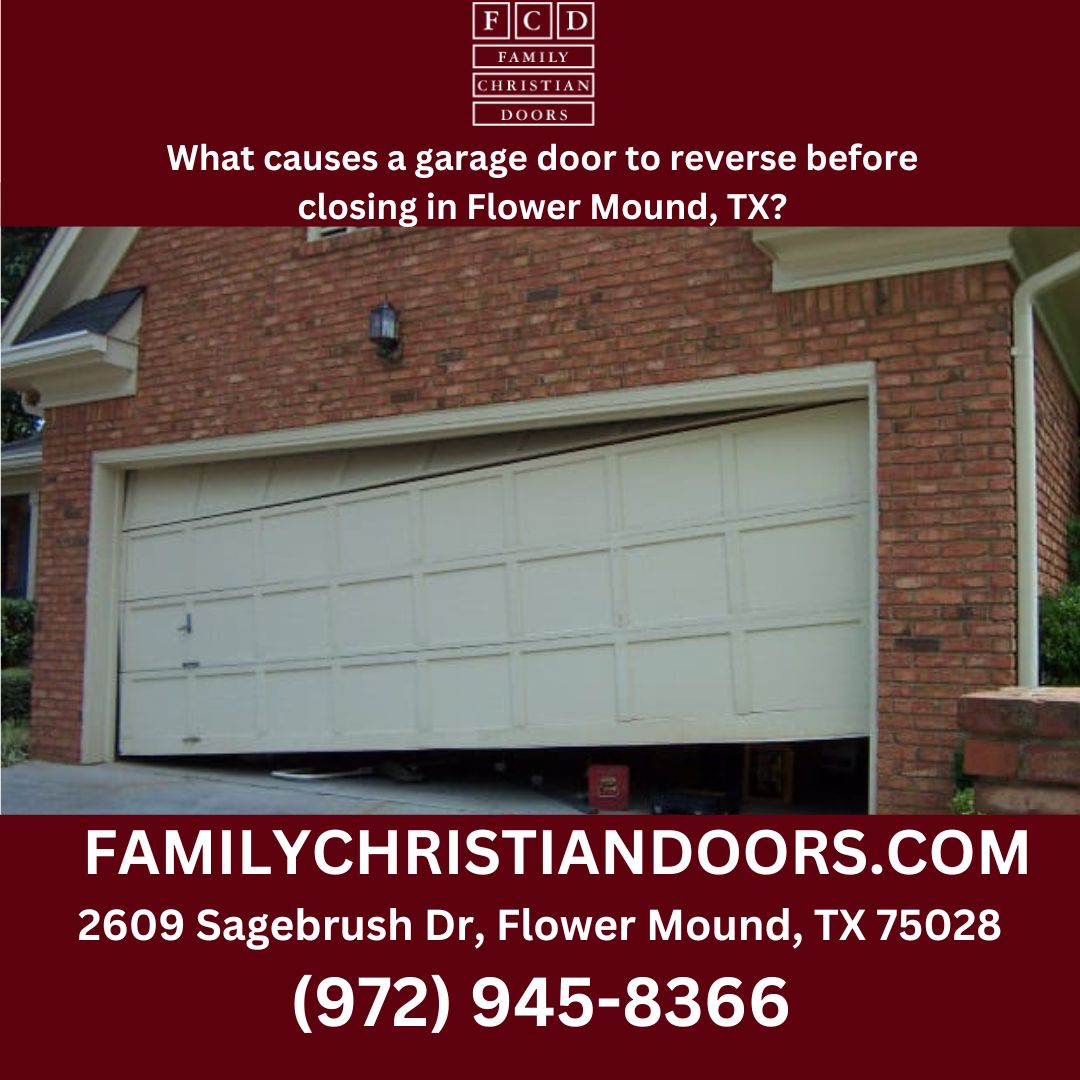
Conclusion
A garage door reversing before it closes is almost always telling you something specific. Whether the cause is a misaligned sensor, a limit switch that needs adjustment, a track obstruction, worn rollers, or an opener sensitivity problem, each issue has identifiable symptoms and a clear path toward resolution. The key is matching the symptom to the correct cause before attempting any adjustment, which prevents unnecessary tinkering and keeps you from masking a deeper problem with a surface-level fix.
For Flower Mound homeowners, the North Texas climate adds an extra layer of consideration. Temperature changes, dust, and seasonal debris all contribute to the kinds of incremental wear that lead to these problems over time. Routine inspection and timely repairs are the most reliable way to keep your garage door operating consistently year-round.
If your garage door is reversing before closing and the cause is not immediately clear from a basic inspection, the team at Family Christian Doors is ready to help. Serving Flower Mound and the surrounding DFW communities, we provide comprehensive Garage Door Opener Service and Repairs and diagnose reversal issues thoroughly and repair them correctly the first time. Visit familychristiandoors.com/garage-door-repair-flower-mound/ to learn more about our services or to schedule your appointment today.