

Garage door and gate openers stop working for a range of reasons, from something as simple as a dead remote battery to more serious issues involving the motor, safety sensors, springs, or the logic board inside the unit. For Dallas homeowners, the problem is rarely random. The city’s intense summer heat, rapid temperature swings in fall and winter, high humidity, and periodic severe storms all create conditions that stress mechanical and electrical components far beyond what manufacturers typically test for in controlled environments. Understanding what failed, and why, is the first step toward knowing whether a quick reset will solve it or whether professional garage door repair is needed before a larger safety issue develops.
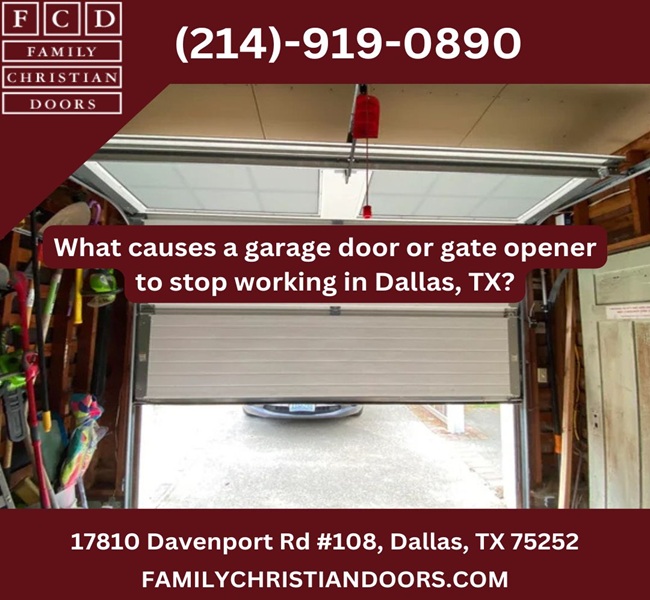
Why Garage Door and Gate Openers Fail and What It Means for Dallas Homeowners
A garage door or gate opener is not a single device. It is a system made up of mechanical components, electrical wiring, safety sensors, a logic board, a drive mechanism, and remote communication hardware, all working in coordination. When any one of those layers breaks down, the entire system can go silent. What makes diagnosis challenging is that a completely unresponsive opener and one that reverses randomly can stem from entirely different root causes. Homeowners in North Dallas, Garland, Mesquite, and across the Metroplex often call for service assuming the motor burned out, only to discover the real issue was a sensor knocked out of alignment by a passing lawn mower or a wall button whose wiring finally gave out after years of heat cycling.
Knowing the most common failure points helps you make a smarter decision about what to check yourself and when to step back and call a licensed technician.
The Most Common Causes of Opener Failure
Power Supply and Electrical Disruptions
Electrical issues sit at the top of the failure list because they are both common and easy to overlook. Before assuming the opener itself is damaged, the power supply is always worth ruling out first.
Tripped Breakers, Blown Fuses, and Unplugged Units
A tripped circuit breaker in your home’s panel can cut power to the opener without any warning. Garage circuits sometimes share a breaker with other high-draw appliances, which increases the chance of a trip. Garage door openers also have a built-in fuse that can blow after a surge or overload. In some cases, the unit simply gets unplugged during a garage cleanout and no one notices. Checking the outlet, the breaker panel, and the unit’s own fuse holder takes only a few minutes and eliminates the most avoidable causes first.
Storm-Related Power Surges Across the Dallas Area
Dallas sits squarely in a storm corridor that produces some of the most intense thunderstorm activity in the country. A nearby lightning strike or a sudden utility restoration after an outage can push a voltage spike through your home’s wiring. That spike often targets sensitive electronics, and the logic board inside your opener is exactly the kind of component that absorbs that damage silently. Homeowners in Carrollton, Lewisville, and Cedar Hill frequently see opener failures in the days following a major storm, even when the unit appeared to survive the event initially.
Remote Control and Wall Button Problems
A non-responsive opener does not always mean the opener itself is at fault. The signal chain between your remote, the antenna, and the receiver board is a separate layer of the system entirely.
Dead Batteries, Signal Interference, and Lost Programming
Remote batteries lose power gradually, and many homeowners do not realize how weak the signal has become until it stops working completely. LED bulbs installed inside the opener unit itself can also emit radio frequency interference that disrupts the remote signal, particularly on older 315 MHz and 390 MHz frequencies. A Limited Garage Door Remote Range is one of the earliest warning signs that battery power or signal interference has started affecting how reliably the opener responds. In some cases, the remote simply loses its programmed code after a power interruption. Wall buttons can also fail independently if the low-voltage wiring behind the button corrodes or a connection works loose over time. Testing the wall button separately from the remote helps isolate which part of the signal chain has broken down.
Safety Sensor Misalignment or Obstruction
Modern garage doors are required by federal safety regulation to include photoelectric sensors near the bottom of the door track. These sensors emit an invisible beam across the opening. If anything breaks that beam, the door will not close, or will reverse immediately after it starts closing. When sensors are the issue, the opener typically still runs, which leads many homeowners to assume the problem is mechanical rather than electrical.
How Dallas Humidity and Debris Affect Sensor Reliability
In East Dallas, Richardson, and Plano, high humidity during late summer can cause condensation to build up on sensor lenses. That film of moisture scatters the beam just enough to trigger a false obstruction reading. Spider webs, dried grass clippings, and dust accumulation can do the same. A Safety Sensor Out of Adjustment is one of the most frequently misdiagnosed opener problems in the Dallas area because the symptom, a door that reverses on its own, looks identical to a mechanical failure at first glance. Sensors also get knocked out of alignment by vehicles bumping the door frame, children running into the brackets, or subtle ground settling that shifts the track slightly. A blinking indicator light on the sensor bracket, or the opener light flashing a specific number of times, usually signals a sensor fault before anything else.
| Failure Cause | Common Signs in Dallas Homes |
|---|---|
| Power supply disruption or surge damage | Opener completely unresponsive; no lights, no motor sound after a storm or outage |
| Remote or wall button failure | Remote does not trigger opener but wall button works, or neither works independently |
| Safety sensor misalignment or obstruction | Door reverses immediately when closing; opener light blinks multiple times |
| Motor, drive belt, or gear wear | Loud grinding or humming sound; motor runs but door does not move |
| Broken torsion spring or snapped cable | Loud bang heard from garage; door hangs crooked or will not lift at all |
Motor, Drive Belt, and Gear Failures
The motor and drive system are the physical heart of the opener. Over time, repeated cycles wear down internal gears, stretch drive belts, and heat up motor windings beyond their rated tolerances. A motor that runs but does not move the door is a reliable indicator that the drive mechanism has failed rather than the motor itself.
Signs the Motor or Drive System Is Breaking Down
Unusual grinding, clicking, or humming sounds during operation are the earliest warnings. A chain or belt that has stretched excessively will also create a loud slapping or rattling noise as it moves. When the Garage Door Gear and Sprocket assembly wears out, the opener activates and the motor runs but the door itself does not move, because the stripped gear can no longer transfer power through the drive system. In some cases, the opener activates but the door moves only partway before stopping, which often points to a gear stripped inside the drive assembly. Homeowners in older Dallas neighborhoods where openers have been in service for ten or more years tend to encounter drive system failures more frequently than those with newer units.
Broken Springs and Snapped Cables
Torsion springs are responsible for counterbalancing the full weight of the garage door, and they carry an enormous amount of stored energy when wound. When a spring breaks, the opener suddenly has to lift a door that weighs several hundred pounds without any mechanical assistance. Most openers are not designed to do that, which is why the door either does not move at all or strains and stops partway up.
How Dallas Heat Cycles Accelerate Spring Wear
Metal contracts in cold weather and expands in heat. In Dallas, springs experience both extremes within the same season, with summer temperatures regularly exceeding 100 degrees Fahrenheit and winter nights occasionally dropping into the teens. That repeated expansion and contraction fatigues the metal faster than in more temperate climates. Springs typically carry a cycle rating from the manufacturer, but Dallas conditions often shorten the real-world lifespan. A Broken Garage Door Spring is one of the most dangerous component failures a homeowner can encounter, and the most common sign is a loud bang from the garage, often mistaken for a car backfire, followed by a door that hangs crooked or refuses to lift at all. Springs should never be adjusted or replaced without professional training, as the stored tension makes them genuinely dangerous to handle.
Limit Switch and Logic Board Malfunctions
Limit switches tell the opener exactly how far to travel before stopping in the open or closed position. When they drift out of calibration, the door may not close fully, may reverse just before hitting the floor, or may stop short of fully opening. Logic board failures are less common but more serious. The logic board is the brain of the system, and when it fails, the opener may behave erratically, stop responding to any input, or show no signs of life at all despite having power at the outlet. Logic board problems often follow a power surge and cannot be resolved without replacement of the board itself.
How Dallas Climate Conditions Make Openers More Vulnerable
Dallas sits in a climate zone that presents unusual mechanical stress compared to most of the country. Summer heat causes lubricants inside the drive assembly to thin and drip away from the surfaces where they are needed most. Rubber components in drive belts, seals, and wiring insulation degrade faster under prolonged UV exposure and triple-digit temperatures. Clay soil across North Texas shifts with moisture content throughout the year, which can subtly change the alignment of door tracks and sensor brackets over time without any visible movement on the surface.
Humidity during spring and early summer creates corrosion on metal contact points in remotes, wall buttons, and sensor terminals. When that corrosion builds up, signal resistance increases until the connection fails. Homeowners in areas like Mesquite and Garland that sit closer to creek drainages tend to see humidity-related corrosion issues more frequently. Factoring in seasonal maintenance is the most effective way to extend the operational life of both the opener and the mechanical components it depends on.
Quick Checks You Can Do Before Calling a Technician
Not every opener failure requires an immediate service call. A few simple checks can help you determine whether the fix is something you can handle or whether a technician needs to take over.
- Check that the opener unit is still plugged into the outlet and the outlet has power by testing it with another device.
- Reset the circuit breaker connected to the garage circuit and try the opener again.
- Replace the batteries in your remote with fresh ones, even if the remote seems recent.
- Look at the safety sensor brackets near the floor on both sides of the door. Confirm that both indicator lights are solid rather than blinking, and gently realign the brackets if they appear to point away from each other.
- Wipe any visible dust or moisture from the sensor lenses with a dry cloth.
- Press the wall button rather than the remote to determine whether the problem is in the remote specifically or in the opener itself.
- Look and listen for anything unusual, including a hanging cable, a gap in the spring, or an off-track door panel. If you see any of those, do not attempt to operate the door further.
When the Problem Is Beyond a DIY Fix
There is a clear line between what a homeowner can safely address and what requires a trained technician. Broken torsion springs, snapped lift cables, off-track doors, and any problem involving the structural integrity of the door system should never be approached as a DIY project. The mechanical forces involved are significant, and attempting a repair without proper tools and training dramatically increases the risk of serious injury.
Logic board replacements, motor assessments, and drive system rebuilds also fall into the professional category. Without the right diagnostic equipment, it is easy to replace a component that was not actually defective while the real problem remains in place. A professional technician can test each part of the system systematically and identify the actual point of failure rather than guessing. For homeowners in Plano, Richardson, Cedar Hill, and throughout the Dallas area, a proper diagnosis often prevents a second service call and a second expense.
Frequently Asked Questions About Garage Door and Gate Opener Failures in Dallas
Why did my garage door opener suddenly stop working with no warning?
Sudden failure without any prior symptoms usually points to one of three causes: a power disruption such as a tripped breaker or blown internal fuse, a logic board failure triggered by a voltage spike, or a complete spring failure. In each case, the system appeared to be running normally right up until the moment it stopped because the underlying issue develops gradually below what is visible or audible. A tripped breaker is the easiest to check and resolve on your own. A logic board or spring failure will require a professional evaluation.
Can a power surge permanently damage a garage door opener?
Yes. A significant voltage spike can permanently destroy the logic board inside the opener, and in some cases it can also damage the motor windings. Dallas homeowners are particularly exposed to this risk because of the frequency and intensity of local thunderstorm activity. In many cases the opener appears completely dead after a surge, with no lights and no response to any input. Surge protectors installed on the garage outlet offer meaningful protection, but they must be rated for the load of the opener and replaced after they absorb a surge since they do not reset automatically.
How do I know if my safety sensors are the problem?
The clearest indicator of a sensor problem is a door that closes partway and then immediately reverses, or one that simply will not start closing at all even though the opener activates. Most opener units will also blink the light on the motor head a specific number of times to indicate a sensor fault. Checking whether both sensor indicator lights are solid green or amber is the fastest visual test. If either light is blinking or off entirely, the sensors are misaligned, obstructed, or have a wiring issue. Realigning the brackets so both lenses face each other directly often resolves the problem, but if the lights remain irregular after adjustment, the sensor wiring or the sensor itself may need replacement.
Does extreme Dallas heat shorten the life of an opener?
It does, in measurable ways. Heat accelerates the degradation of rubber components, thins lubricants out of the moving parts that need them most, stresses motor windings during heavy use periods, and increases the rate at which metal fatigue accumulates in springs and cables. Manufacturers typically publish component ratings based on temperate climate assumptions. Real-world lifespan in a Dallas garage, particularly one without climate control, tends to run shorter than those published figures suggest. Annual lubrication with a product rated for high temperatures, combined with a professional inspection every one to two years, goes a significant distance toward preserving the system across the full Dallas climate range.
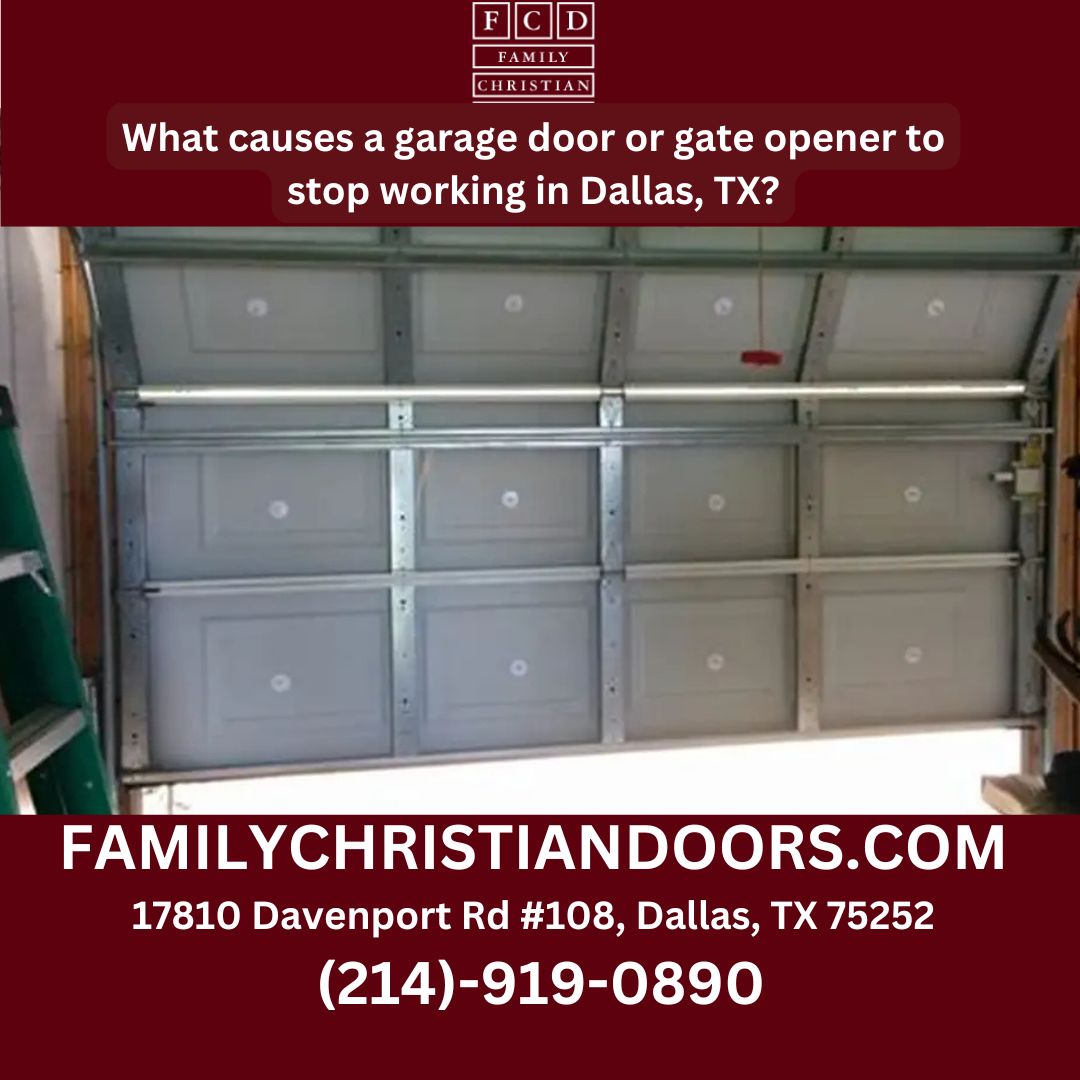
The Bottom Line for Dallas Homeowners
What causes a garage door or gate opener to stop working in Dallas comes down to a combination of component wear, environmental stress, and the kind of electrical exposure that comes with living in one of the most storm-active regions in the country. Power disruptions, sensor misalignment, remote failures, motor and drive wear, broken springs, and logic board damage each present differently, and getting to the right repair starts with an accurate diagnosis of the actual failure point.
Some situations are straightforward enough to troubleshoot at home. Others, particularly those involving structural components like springs and cables or internal electronics like the logic board, carry real safety risks when approached without professional training and tools. Family Christian Doors has been serving homeowners across the Dallas area with the kind of thorough, experience-backed service that gets the diagnosis right the first time. If your opener has stopped working and you are ready to get a clear answer about what is actually wrong, visit familychristiandoors.com/garage-door-repair-dallas/ to learn more or get in touch with the team.