

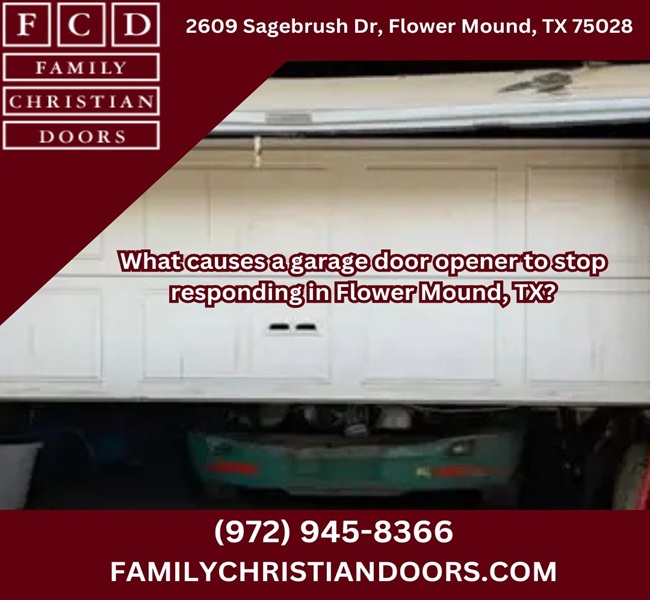
A garage door opener that stops responding is almost always caused by one of five issues: dead remote batteries, a tripped circuit breaker, misaligned safety sensors, a worn internal component, or heat and humidity damage to the electronics. For homeowners and business owners in Flower Mound, TX, the local climate adds a layer of stress on opener systems that many people do not consider until something fails. Understanding what is happening inside the unit helps you diagnose faster and decide when to troubleshoot yourself and when to call for professional garage door repair.
The Most Common Reasons a Garage Door Opener Goes Silent
Dead or Weakened Remote Batteries
This is the most frequently overlooked cause. A remote with partially drained batteries may work sporadically or only at close range before going silent. If you have to press the button several times or stand right in front of the door for it to register, replace the batteries first. In Flower Mound’s summer heat, batteries stored in a hot car or garage lose capacity faster than the manufacturer’s estimate.
Tripped Circuit Breaker or Lost Power to the Unit
An opener with no lights and no sound has likely lost power. Test the outlet the motor is plugged into with another device. If the outlet is dead, check your breaker panel for a tripped garage circuit. During North Texas storm season, power fluctuations regularly trip breakers without any visible damage to the unit. A GFCI outlet that needs a reset is also worth checking before assuming a hardware failure.
Safety Sensor Problems That Freeze the Opener
Modern openers will refuse to close when the safety sensor circuit is broken. The two sensors near the floor on each side of the door communicate constantly, and when that signal is interrupted, the opener treats it as a safety condition and stops.
Misaligned Sensors After a Storm or Vibration
High winds, a hard door slam, or a bump from a yard tool can knock a sensor bracket off alignment. When sensors are misaligned, the indicator lights will blink amber instead of holding steady green, which is a clear indicator of a Safety Sensor Out of Adjustment. Re-aligning the bracket and tightening the wing nut is often all it takes to restore normal operation.
Obstructed Sensor Eyes and Dirty Lens Buildup
Flower Mound’s pollen season, humidity, and seasonal dust mean sensor lenses accumulate grime faster than in drier climates. A thin layer of dust or spider web residue is enough to block the infrared beam and trigger a fault condition. Wiping both lenses with a dry cloth takes under a minute and is worth doing before scheduling a service visit.
How Flower Mound’s Climate Accelerates Opener Failures
Heat and Thermal Cycling Effects on Logic Boards and Wiring
The logic board controls remote signals, travel limits, and the safety circuit. Repeated exposure to DFW’s triple-digit summer heat followed by sharp winter cooling causes solder joints on the board to expand and contract over time. This produces hairline fractures that lead to intermittent failures. If your opener works fine in the morning but stops responding during afternoon heat, a thermally damaged logic board is a strong candidate.
Humidity and Condensation Inside the Motor Housing
North Texas humidity levels, especially during spring and fall, push moisture into motor housings and electrical connections. Condensation corrodes terminal contacts and wire connectors in ways that are invisible from the outside but sufficient to degrade signal transmission and produce a dead response from an otherwise intact unit.
Internal Component Failures That Stop the Opener Cold
Worn Gear and Sprocket Assembly
The Garage Door Gear and Sprocket assembly transfers motor power to the drive mechanism that moves the trolley and door. When these plastic gears strip, the motor runs but nothing moves. You will hear the motor humming while the door sits still. In high-use residential garages that cycle multiple times per day, gear assemblies can wear out well before the ten-year mark.
Signs the Drive Gear Is the Culprit vs. the Motor Itself
If the motor runs but the trolley does not move, the gear assembly is the likely failure. If there is complete silence when you trigger the opener, the motor or its power supply is the more probable cause. A stripped gear is a component-level fix. A dead motor typically means the full unit needs replacement.
Damaged or Disconnected Wiring Inside the Unit
Wiring between the logic board, motor, and wall button terminal can work loose from vibration over time, or sustain damage from rodents in the garage. A disconnected wall button wire will take the wall button offline while the remote continues to work, which is a useful symptom to note when narrowing down the cause.
When the Remote Works but the Wall Button Does Not (or Vice Versa)
What That Symptom Pattern Tells a Technician
Remote works, wall button does not: the problem is almost certainly in the wall button wiring or the button itself. Wall button works, remote does not: the issue is the remote, its batteries, or the motor head antenna. Neither works: the fault is in the unit itself, pointing to the logic board, power supply, or sensor circuit.
Lock Mode Engaged: The Simple Setting Homeowners Miss
Most LiftMaster and Chamberlain openers include a lock mode that disables remote signals while still allowing the wall button to function. It is easy to activate by accident. If your remote suddenly stops working but the wall button still operates the door normally, check whether lock mode is active or whether a Garage Door Opener Remote Replacement is needed before assuming any hardware has failed.
Residential vs. Commercial Opener Failures: Key Differences
Why Commercial Units in Flower Mound Face Higher Duty-Cycle Stress
A commercial garage door at a warehouse, service bay, or loading dock may cycle dozens of times per day compared to three to five cycles in a home garage. That volume compresses the wear timeline for gears, drive components, and operator boards. A component that lasts a decade in a residential setting can fail within two to three years under commercial demand.
Operator Board Failures in High-Frequency Industrial Applications
Commercial operators face more vibration and wider temperature swings than residential units. Logic board failures in these environments often appear as intermittent response, random reversals, or complete signal loss during peak afternoon heat. These symptoms are regularly misread as remote or sensor problems before the board itself is properly tested.
What to Check Before Calling for Service
A Quick Self-Diagnostic Sequence
Running through a short checklist can either solve the problem or give a technician useful information before arriving.
- Replace remote batteries regardless of how recently you changed them.
- Test the outlet and check the circuit breaker for the opener.
- Look at the sensor indicator lights near the floor on both sides of the door.
- Clean both sensor lenses with a dry cloth.
- Test the remote and wall button separately and note which responds and which does not.
| Symptom Observed | Most Likely Cause |
|---|---|
| No lights, no sound from the unit | Tripped breaker or lost outlet power |
| Motor runs but door does not move | Stripped gear and sprocket assembly |
| Sensor indicator light blinking amber | Misaligned or obstructed safety sensor |
| Remote fails, wall button still works | Dead batteries, weak signal, or lock mode active |
| Works in the morning, fails in afternoon heat | Logic board damaged by thermal cycling |
When It Is Time to Call a Professional
If the checklist above does not resolve the issue, or symptoms point to a logic board, wiring, or gear failure, a trained technician is the right next step. In cases where the motor has failed entirely, a full Garage Door Opener Replacement may be the most reliable path forward. Attempting repairs on a logic board or motor assembly without proper training can cause additional damage, especially in commercial settings where the opener handles a heavy door under repeated daily load. Intermittent failures that track with afternoon heat are also worth addressing now rather than waiting for a complete shutdown when summer temperatures in Flower Mound peak.
Conclusion
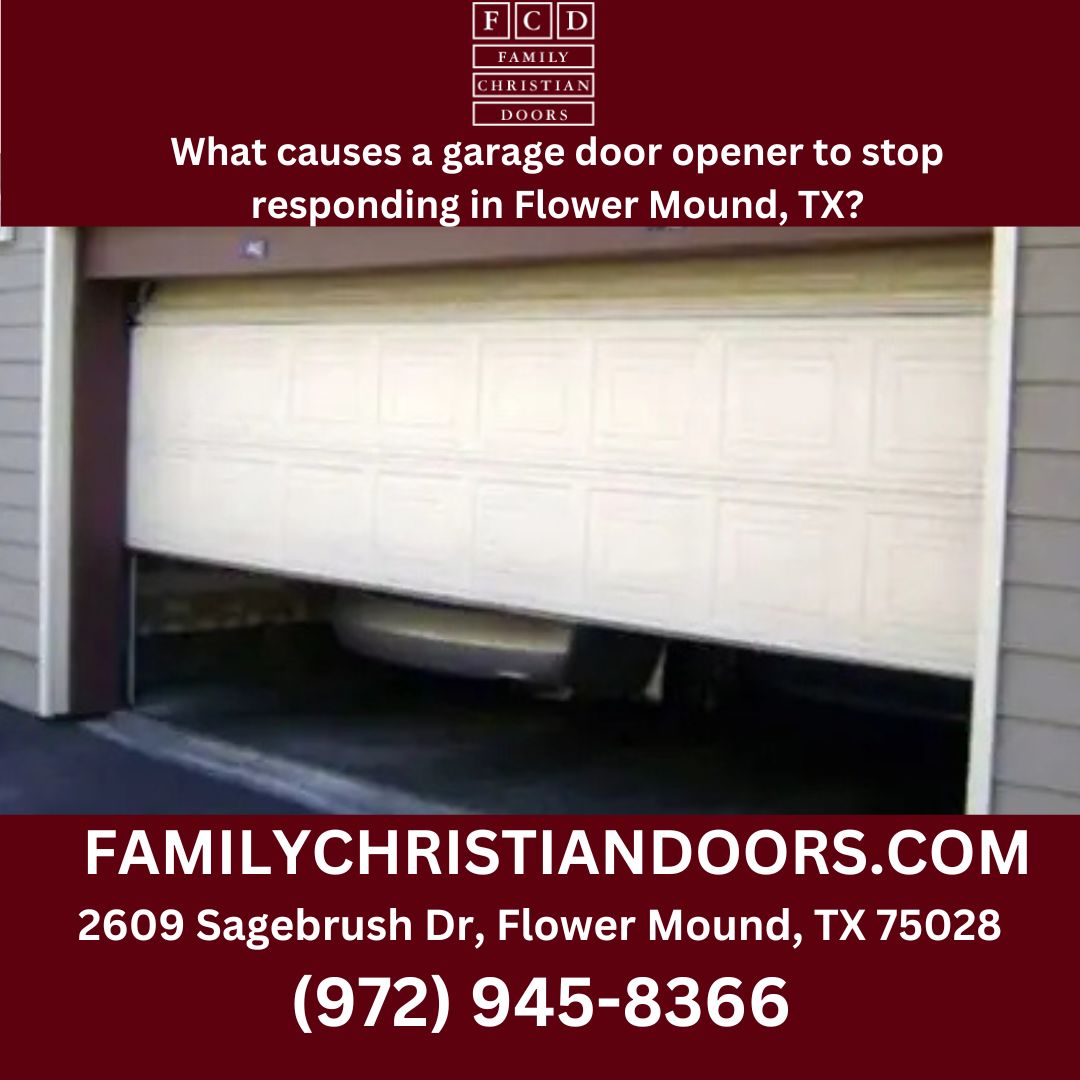
A non-responsive garage door opener almost always has an identifiable cause. In Flower Mound and the broader DFW area, extreme summer heat, high humidity, and severe storm season make certain failure modes more common and accelerate component wear that would develop more slowly in a milder climate. Whether the issue is something as simple as dead batteries or as involved as a heat-damaged logic board, matching the symptom pattern to the right cause saves time and avoids unnecessary repairs.
Family Christian Doors has the experience to diagnose and resolve opener failures across residential and commercial systems throughout Flower Mound, TX. If your opener is not responding and the basic checks have not helped, reach out or visit familychristiandoors.com/garage-door-repair-flower-mound/ to schedule service with a technician who knows these systems and this climate.