

Garage doors and automatic gates fail to open or close properly for many of the same core reasons: mechanical wear, electrical failure, sensor interference, or structural damage. In Dallas, those problems are made worse by one of the most demanding climates in the country. Triple-digit summer heat, sudden temperature drops in winter, and persistent humidity put stress on components that homeowners in milder regions never have to think about. Understanding the specific cause behind a malfunction is the first step toward solving it quickly and safely, whether you are dealing with a residential garage door repair in Plano or a commercial swing gate in North Dallas.
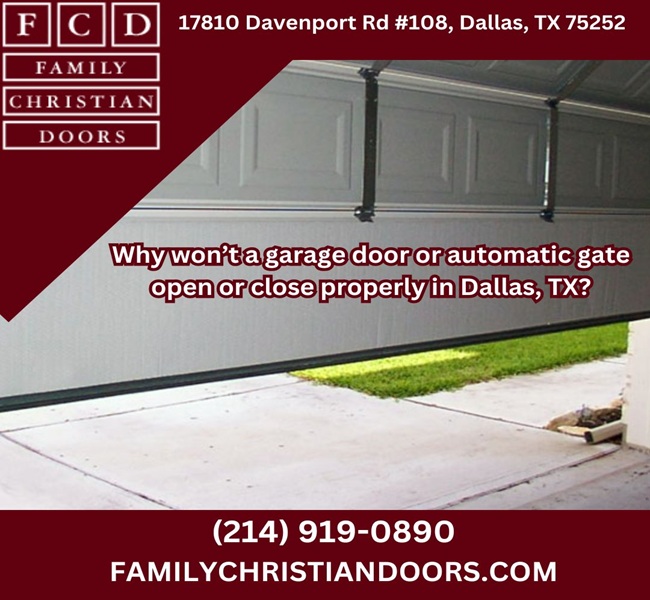
The Most Common Reasons Garage Doors and Automatic Gates Fail in Dallas
Before diving into specific diagnoses, it helps to understand why the Dallas climate creates so many repair calls that other cities simply do not see at the same rate. This is not just about age or wear. It is about environmental pressure applied year-round to components that were engineered to handle average conditions, not Texas conditions.
How Dallas Heat and Humidity Stress Mechanical Components
Dallas sits in a climate zone where summer temperatures routinely climb above 100 degrees Fahrenheit and winter nights can drop below freezing within the same month. That kind of thermal cycling is punishing to metal parts, rubber seals, lubricated components, and circuit boards alike.
What Extreme Temperature Swings Do to Springs and Cables
Springs and cables are made from high-tension steel, and steel expands and contracts based on temperature. In Dallas, a torsion spring above a garage door can go through hundreds of expansion-contraction cycles each year just from seasonal temperature shifts, before a single open-and-close cycle is counted. Over time, that repeated stress causes metal fatigue, coil distortion, and eventual fracture. Cables, which work in tandem with springs to balance the door’s weight, experience the same wear pattern. When either component fails, the door will either refuse to move or move in a lopsided, jerking motion that puts additional strain on the opener motor.
How Summer Humidity Causes Electrical and Sensor Corrosion
Dallas summers bring not just heat but high relative humidity, particularly in the eastern parts of the metro including Garland, Mesquite, and Rowlett. That moisture seeps into circuit boards, sensor housings, and wiring connections. Over time, it causes corrosion on contact points that leads to intermittent signal failures. A gate or garage door opener that works on some days but not others is often experiencing exactly this kind of humidity-driven electrical degradation. The problem is not always visible to the naked eye, which is one reason many homeowners cycle through battery replacements and remote reprogramming before discovering the real issue.
Garage Door Won’t Open or Close: Diagnosing the Problem
A garage door that refuses to move is one of the most disruptive household failures a Dallas homeowner can face, especially during the summer months when an attached garage can turn dangerously hot within minutes of losing ventilation. Diagnosing the problem correctly the first time saves both time and money.
Spring and Cable Failures: The Most Dangerous Diagnosis
Spring failure is the single most common cause of a garage door that will not open. When a torsion spring breaks, the opener motor typically cannot generate enough force to lift the door on its own. You may hear the motor running but see no movement, or the door may lift a few inches and then stop. In some cases, the door rises unevenly, indicating a cable has snapped or come off its drum on one side. A Broken Garage Door Spring is one of the most critical repairs a Dallas homeowner should never attempt without professional help.
Signs Your Torsion or Extension Springs Have Failed
A broken torsion spring will often appear as a visible gap in the coil above the door. You may also notice the door feels extraordinarily heavy when you attempt to lift it manually after disconnecting the opener. Extension springs, which run along the horizontal tracks on either side of the door, can snap completely or lose tension gradually, causing the door to feel imbalanced. Either situation requires professional service. High-tension springs store a significant amount of mechanical energy, and attempting to adjust or replace them without the proper tools and training has caused serious injuries in DIY repair attempts across the Dallas area.
Garage Door Opener and Circuit Board Issues
When springs and cables check out but the door still does not respond, the problem often lives inside the opener unit mounted to the ceiling of the garage. Opener motors, logic boards, and capacitors are all vulnerable to the heat buildup that occurs in a Dallas garage during summer months. A garage with poor insulation can reach interior temperatures well above 120 degrees Fahrenheit on a July afternoon, which is well beyond the safe operating threshold for many opener circuit boards. Scheduling Garage Door Opener Service and Repairs at the first sign of sluggish or inconsistent performance can prevent a minor electrical issue from becoming a full system failure.
How Dallas Power Surges and Heat Damage Opener Logic Boards
North Texas is no stranger to severe weather. Spring and summer thunderstorms frequently produce power surges that travel through home electrical systems and fry sensitive electronics, including garage door opener control boards. A door that was working fine before a storm and will not respond afterward is almost always dealing with a surge-related circuit board failure. In other cases, the board degrades slowly over months of heat exposure until one day the opener simply stops sending a signal to the motor. Replacing a damaged logic board is a straightforward job for a trained technician, but diagnosing it as the root cause first requires ruling out the receiver, wiring, and remote transmitter.
Misaligned Safety Sensors and Photo Eyes
Federal law requires all residential garage door openers manufactured after 1993 to include photo-eye safety sensors mounted near the floor on either side of the door. These sensors send an invisible beam across the opening, and if that beam is broken or misaligned, the door will refuse to close completely. This is a safety feature, not a malfunction, but it can feel identical to one if you do not know what to look for.
How Dust, Debris, and Sun Angle Misalign Dallas Garage Door Sensors
In areas like West Dallas and Grand Prairie, where dry winds carry significant amounts of dust, sensor lenses can accumulate a fine film of grime that scatters the beam and triggers false obstruction readings. Lawn debris, spider webs, and even a garden hose knocked against a sensor bracket can knock the units out of alignment. A Safety Sensor Out of Adjustment is one of the easiest problems to misread as a major malfunction, which is why proper diagnosis always starts at the sensor level before moving to the opener or motor. There is also a lesser-known issue specific to the Dallas sun angle in late afternoon: direct sunlight hitting a photo-eye receiver can overpower the sensor signal and make the opener believe an obstacle is present. If your door closes fine in the morning but refuses to close in the afternoon, this is worth checking before assuming a more serious problem.
Off-Track Doors: When the Problem Goes Beyond the Opener
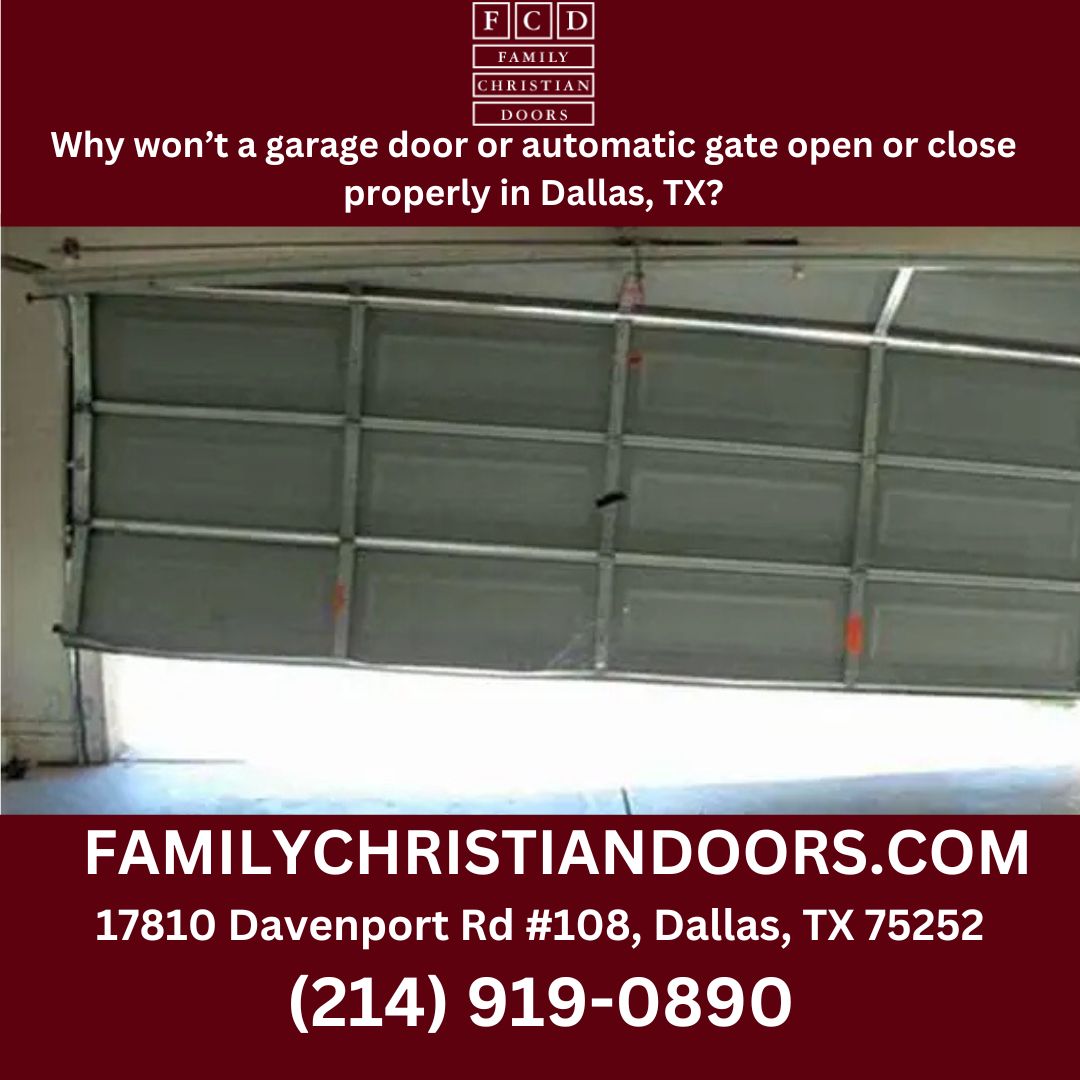
A garage door that has come off its tracks will not open or close regardless of how functional the opener is. Off-track conditions usually result from a broken spring that allowed the door to drop unevenly, a vehicle collision with the door, or damaged rollers that can no longer stay seated in the track channel. In Dallas neighborhoods with detached garages built in the 1980s and 1990s, worn steel rollers are a particularly common culprit. The door may still move slightly when the opener activates, but it will grind, bind, or stop before completing its travel. Attempting to force the door open or closed in this condition risks bending the track permanently, which turns a repair job into a more involved replacement.
Automatic Gate Won’t Open or Close: Diagnosing the Problem
Automatic gates share many of the same failure modes as garage doors, but they also have unique vulnerabilities tied to their outdoor exposure, larger size, and more complex structural requirements. A gate that fails to open or close in Dallas is not always a motor problem. It may be a foundation issue, a charging system problem, or simple structural fatigue from years of environmental exposure.
Gate Opener Motor and Circuit Board Failures
Just like garage door openers, automatic gate motors and their associated circuit boards are sensitive to heat and electrical disturbances. Gate openers mounted outdoors face an even harsher environment than indoor garage openers. Direct sun exposure on a gate operator housing during a Dallas summer can push internal component temperatures to damaging levels, particularly if the housing ventilation is blocked by debris or insect nesting.
How Heat Cycles and Charging System Problems Affect Gate Motors
Many residential gate openers in Dallas use a battery backup system that is charged by an onboard solar panel or AC connection. When the charging system fails, the battery depletes and the gate stops responding. This is one of the most misdiagnosed gate problems in the field, because the gate appears to have no power, leading homeowners to assume the motor has burned out. A failing battery or bad charging circuit is far less expensive to address than a motor replacement, which is why proper diagnosis matters so much. Heat accelerates battery degradation significantly in outdoor installations, and batteries in Dallas gate openers typically have a shorter usable life than the manufacturer’s stated average.
Hinge, Caster, and Structural Gate Issues
A gate that moves slowly, stops before fully opening, or emits grinding sounds during travel may not have any electrical problem at all. The issue may be entirely mechanical. Hinges corrode over time, especially in areas near sprinkler systems where repeated water contact accelerates rust. Casters on slide gates wear down unevenly and can jam in the track, forcing the motor to work against physical resistance rather than smoothly propelling the gate through its arc or path.
When a Leaning Gate Post Signals a Bigger Problem
In neighborhoods across Richardson, Sachse, and other parts of the Dallas metro built on expansive clay soil, gate posts can shift, lean, or heave as the soil contracts and expands through dry and wet seasons. A gate post that has moved even a few inches out of plumb will cause the gate to bind at the latch point, drag along the ground, or place abnormal torque on the hinge hardware. The opener will fight this resistance until either the motor overheats, the circuit board triggers an obstruction fault, or the hinge hardware fails entirely. When this structural condition exists, repairing the electrical system alone will not solve the problem. The post must be addressed first.
Limited Remote Range on Automatic Gates
A gate opener that only responds when you pull your vehicle within a few feet of the receiver is experiencing signal range degradation. While this does not prevent operation entirely, it disrupts the user experience and often indicates a deeper issue that will eventually lead to complete failure. The same pattern applies to residential garage systems, where Limited Garage Door Remote Range is frequently the first warning sign that a receiver, transmitter, or circuit board is beginning to fail.
Interference, Battery Drain, and Receiver Problems in DFW
The Dallas-Fort Worth metro is one of the most radio frequency-dense environments in the country. Cellular towers, emergency service transmitters, and smart home device networks all operate on overlapping frequency ranges that can interfere with gate opener receivers. In addition, the heat-related battery drain discussed earlier reduces transmitter output strength, which shortens the effective range of the remote. If range problems appear gradually over weeks rather than suddenly overnight, the cause is usually a weakening battery or a receiver that has degraded from moisture exposure. If the problem appeared suddenly, radio frequency interference from a new device or installation nearby is worth investigating.
A Diagnostic Comparison: Garage Doors vs. Automatic Gates
The table below summarizes the most common symptoms and their likely root causes across both system types, providing a quick reference for homeowners trying to identify what they are dealing with before calling for service.
| Symptom | Most Likely Cause |
|---|---|
| Door or gate moves a few inches then stops | Broken spring, obstructed track, or opener obstruction fault triggered by a mechanical bind |
| Opener motor runs but nothing moves | Broken torsion spring on garage door, or failed drive gear on gate opener disconnected from the gate arm |
| Door or gate will not close but opens fine | Misaligned or dirty photo-eye sensors on garage door, or obstruction sensor fault on gate opener |
| No response from remote or keypad | Dead remote battery, failed receiver, damaged circuit board, or dead backup battery on gate system |
| Grinding or scraping sound during operation | Worn rollers off track on garage door, or corroded hinges and worn casters on slide or swing gate |
When DIY Diagnosis Becomes a Professional Repair
There is a meaningful difference between homeowner-level inspection and hands-on repair work when it comes to garage doors and automatic gates. Visual inspection, cleaning sensor lenses, replacing remote batteries, and checking for obvious obstructions are all reasonable first steps. What crosses the line into professional territory is anything that involves high-tension springs, electrical components, track realignment, or structural post assessment.
Safety Risks That Require a Licensed Technician
Torsion springs on residential garage doors are under hundreds of pounds of tension even when the door is in the closed position. A spring that is not properly wound down before being handled can release that stored energy instantly, causing severe injury. The same caution applies to gate opener electrical systems, particularly those with capacitors that retain a charge after power is disconnected. Professional technicians carry the winding bars, locking clamps, and safety protocols that make these repairs survivable. Attempting them without the right equipment is one of the leading causes of home repair injuries in the garage and driveway space.
Why Dallas Homeowners in Plano, Richardson, and North Dallas Should Not Delay
In the Dallas summer, a garage door that will not open or close is not just an inconvenience. It is a safety and security exposure. A door stuck open leaves your home vulnerable. A door stuck closed traps vehicles, blocks emergency egress, and turns your garage into an oven. The longer a mechanical problem is left unaddressed, the more likely secondary damage becomes: a worn roller left grinding in its track will eventually damage the track itself, turning a simple roller replacement into a track replacement job. Acting quickly at the first sign of trouble is always the most cost-effective approach for Dallas-area homeowners.
Conclusion
Garage doors and automatic gates fail to open or close properly in Dallas for a specific and diagnosable set of reasons. Springs break under thermal fatigue. Circuit boards corrode from humidity and fry from power surges. Sensors drift out of alignment from dust, debris, and direct sunlight. Gate posts shift in the clay soil unique to North Texas. Charging systems degrade faster in extreme heat. Each of these causes has a solution, but identifying the right one requires methodical diagnosis rather than guesswork.
Family Christian Doors serves homeowners and businesses throughout the Dallas area with experienced technicians who understand how the local climate affects every component of your garage door and gate system. If your door or gate is not behaving the way it should, the right answer starts with a proper evaluation by someone who has seen these exact conditions hundreds of times across the DFW metro.
To learn more or schedule a service call, visit the Family Christian Doors Dallas service page at familychristiandoors.com/garage-door-repair-dallas and get the problem diagnosed correctly the first time.