

Deciding between repair and replacement for your garage door is one of the most common questions homeowners and commercial property managers in Flower Mound face. A malfunctioning garage door disrupts your daily routine, creates security concerns, and can cost you money—whether through repeated repairs or a full replacement. Understanding when garage door repair makes sense versus when replacement is the smarter investment requires looking at several key factors: the age of your door, the cost of repairs, the severity of damage, and your long-term budget priorities. This guide walks you through the decision-making framework to help you choose the right path forward.
Understanding the Replacement vs. Repair Decision Framework
Why This Decision Matters More in Texas
Climate stress on garage door components
Flower Mound’s Texas climate creates unique challenges for garage doors. Extreme heat, humidity fluctuations, and occasional ice storms put continuous stress on metal springs, hinges, rollers, and seals. The combination of intense summer heat and rapid temperature changes accelerates rust development on steel doors and weakens rubber weatherstripping faster than in milder climates. This environmental stress means components fail more frequently and earlier than they would in other regions, making the repair versus replacement decision more complex and urgent.
Age + environment impact on lifespan
While a well-maintained garage door typically lasts 15-20 years in moderate climates, the Texas environment can reduce that lifespan significantly. Components that might last a decade elsewhere may fail in 7-10 years here. When you’re evaluating whether to repair an aging door, factor in that Flower Mound’s climate is already working against you, shortening the remaining useful life of your investment.
The Cost-Benefit Analysis You Need to Know
Repair costs that signal replacement time
Not all repairs are created equal. Minor repairs like replacing weatherstripping or adjusting a sensor are inexpensive and make sense at any age. But when you’re facing a broken garage door spring, a failed opener motor, or extensive rust damage, the cost equation shifts dramatically. Residential spring replacement typically runs $250-$400, while commercial-grade spring systems can exceed $600. These individual repair costs need context: if your door is 12+ years old and you’re spending $400 on repairs today, you could be spending $800 next year.
Hidden costs of repeated repairs (residential vs. commercial)
The true cost of repair isn’t just the immediate service call. Each repair comes with a service fee, parts cost, and labor. For residential homeowners, calling a technician for a single repair might cost $150-$250 just for the visit. For commercial properties with high-traffic garage doors, repeated repairs quickly compound—what seems like a $300 fix today could cascade into $1,500 in repairs over 18 months if underlying issues aren’t addressed. This cumulative cost is often where the “repair versus replacement” equation tips toward replacement.
Critical Signs Your Garage Door Needs Replacement
Age-Based Indicators
Residential doors (15+ years)
If your residential garage door is 15 years or older, you’re living on borrowed time. Springs, rollers, and openers all have finite lifespans. While a 15-year-old door might still operate, replacement is worth serious consideration—especially if you’ve already invested in repairs. A new door comes with modern safety features, improved insulation, and a warranty that protects you from unexpected failures.
Commercial doors (10-12 years in high-use settings)
Commercial garage doors that experience daily use—loading docks, service entrances, parking garages—have shorter replacement windows. Heavy use accelerates component wear by 30-40% compared to residential doors. If your commercial door is approaching 10-12 years with regular use, replacement planning should begin, especially if repairs are becoming frequent.
Performance Red Flags
Safety sensor failures
Garage door safety sensors that are misaligned or failing indicate your door’s safety system is compromised. This is a serious issue that demands immediate attention, but a failing sensor in an aging door system might be a sign of broader system degradation. If sensors repeatedly fail even after adjustment, or if other components are also showing wear, replacement may be more cost-effective than repeated sensor repairs.
Opener strain and unusual noises
A grinding, squealing, or struggling sound when your door opens and closes signals that the opener is working harder than it should. This often indicates misalignment, worn rollers, or a damaged track. In a newer door, these are repairable. In a 10+ year old door, these noises often signal multiple wear points and suggest the entire system is nearing the end of its functional life.
Spring deterioration (most common replacement trigger)
Your garage door springs are under enormous tension and are typically the first component to fail. A broken spring requires immediate replacement for safety reasons. However, if your door is already 12-15 years old and a spring breaks, this is often the trigger point for replacement decisions because additional failures are likely imminent.
Structural & Damage Concerns
Rust penetration on steel doors
Surface rust can be managed, but rust penetration that’s creating holes or weakening the panel structure is a replacement indicator. In Flower Mound’s humid Texas climate, rust spreads quickly once it begins compromising the integrity of the door. Extensive rust repair is expensive and temporary; replacement addresses the problem permanently.
Panel damage beyond cosmetic
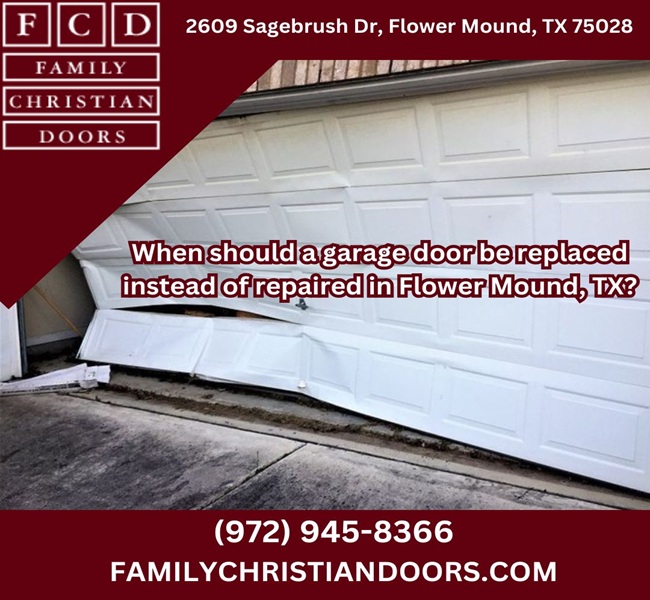
A dent in a panel is cosmetic. But if panels are cracking, warping, or separating from the frame, structural integrity is compromised. In these situations, replacement is almost always more economical than individual panel replacement, especially for older doors where matching panels may not be available.
Misalignment patterns
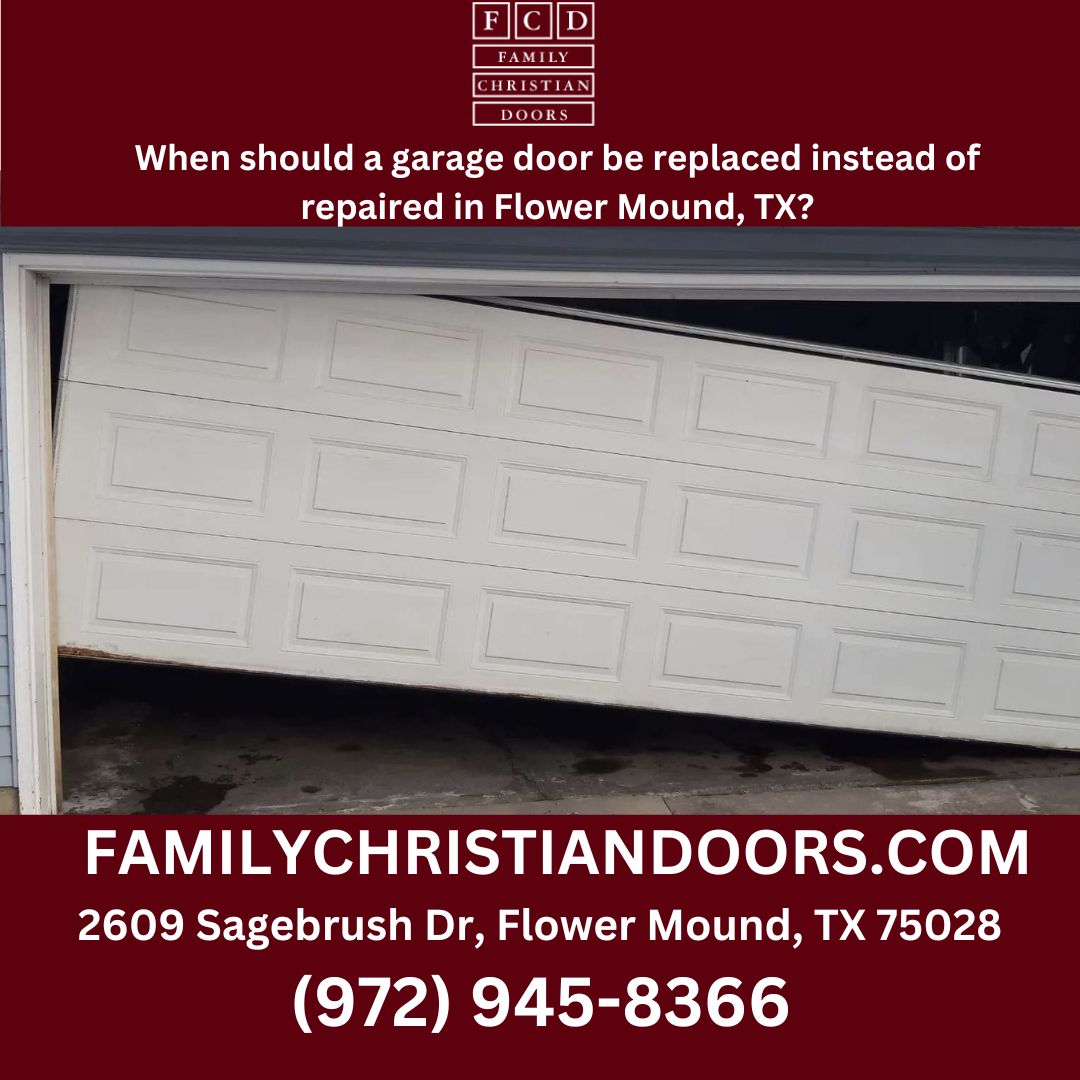
If your door tracks are repeatedly going off-alignment, it suggests the frame itself may be warping or settling. Repeated track adjustment is a band-aid solution that will eventually fail. Chronic misalignment often signals that a full system replacement is needed.
When Repair Is Still the Right Choice
Single-Component Failures (Repair Territory)
Spring replacement (residential)
A single spring failure in a door that’s less than 10 years old should absolutely be repaired, not replaced. Spring replacement is a standard service that costs far less than a new door and restores full functionality. This is textbook repair territory.
Roller and hinge issues
Worn rollers and hinges are wear items that should be replaced. These repairs are typically $100-$300 and don’t signal broader system failure. A door with new rollers can run smoothly for years.
Weatherstripping deterioration
Cracked or peeling weatherstripping should be replaced, not replaced along with the entire door. This is an inexpensive fix that improves energy efficiency and prevents water intrusion.
New Door Scenarios (Less Than 5 Years Old)
Warranty coverage advantages
If your garage door is less than 5 years old, it should still be under warranty. Any failure should trigger warranty service, which is free or low-cost. Never pay full repair cost for a door still under manufacturer protection.
Labor-only vs. full replacement costs
For new doors, repair labor is minimal cost compared to replacement. A residential garage door replacement typically costs $1,500-$3,500 installed. If your warranty covers parts and labor for a repair costing $200-$500, that’s an obvious financial decision.
Flower Mound-Specific Factors in the Replacement Decision
Texas Heat & Humidity Impact
How DFW climate accelerates wear
Aluminum corrosion, rubber seal degradation, and rust development all accelerate in North Texas weather. A door that might last 18 years in a dry climate may only last 12 years here. When calculating repair versus replacement for a 10-12 year old Flower Mound garage door, assume you have less remaining lifespan than national averages suggest.
Energy efficiency gains from modern insulation
Modern insulated garage doors with polyurethane or polystyrene cores are significantly more efficient than doors from 10+ years ago. For commercial properties especially, the energy savings from a new insulated door can offset replacement costs within 5-7 years. This long-term value often makes replacement more attractive than continued repair of an older, uninsulated door.
Local Building Codes & HOA Considerations
Residential HOA restrictions in Flower Mound communities
Many Flower Mound neighborhoods have HOA guidelines about garage door style, color, and material. If your door is aging and you’re planning replacement, verify HOA requirements early. Some HOAs restrict options, while others offer flexibility. This local context can influence repair versus replacement timing.
Commercial door compliance requirements
Commercial properties must meet specific safety codes that change over time. An older commercial door may not meet current wind load ratings or safety standards. Replacement often isn’t optional—it’s required for code compliance. When evaluating commercial door repairs, always verify that older doors still meet current building codes.
Financial Reality Check: Repair vs. Replacement Costs
When Repair Costs Approach Replacement
The 50% threshold rule
A common industry guideline: if repair cost exceeds 50% of replacement cost, replacement is typically the better choice. For residential doors, replacement runs $1,500-$3,500. If repair estimates exceed $750-$1,750, replacement deserves serious consideration. This rule isn’t absolute, but it’s a useful financial checkpoint.
Residential examples (typical repair ranges)
A residential spring replacement: $250-$400. An opener motor replacement: $300-$600. A failed safety sensor out of adjustment service call: $150-$250. Two or three of these repairs in a 12-month period on a 14-year-old door suggests replacement is approaching.
Commercial examples (high-traffic door repair costs)
A commercial door opener replacement can run $800-$1,500. Structural panel replacement on commercial doors often exceeds $400-$600 per panel. Commercial dock leveler door repairs compound quickly. When facing $1,000+ in repairs on a 10-year-old commercial door, replacement becomes financially competitive.
Long-Term Investment Value
Warranty protection with new doors
A new garage door comes with manufacturer warranties (typically 5-10 years on parts, 1-2 years on labor). This warranty coverage eliminates repair uncertainty for years. Comparing that peace of mind and protection against the escalating repair costs of an aging door helps frame replacement as an investment, not just an expense.
Energy savings projection
An insulated replacement door reduces heating and cooling loss through your garage, particularly valuable in Flower Mound’s extreme heat. While exact savings depend on garage conditioning practices, upgrading from an uninsulated to an insulated door can save 5-10% on garage-area climate control costs annually. Over 15 years, this compounds to meaningful savings.
Frequency of future repairs
An aging door that required two repairs last year will likely need two more repairs this year. Projecting the cumulative cost of repairs over the next 3-5 years often reveals that a single replacement investment is cheaper than the repair treadmill.
Next Steps: Getting a Professional Assessment
What to Expect From a Garage Door Inspection
Questions they’ll evaluate
A professional technician will assess door age, document existing damage, test safety sensors, evaluate spring and opener condition, and examine the track alignment. They’ll provide written documentation of their findings—not just a repair quote, but a clear assessment of overall system health and remaining lifespan.
Documentation they should provide
The inspection should include photos of damage or wear areas, a clear explanation of what’s failing, a repair estimate if repair is viable, and ideally a replacement estimate so you can compare your financial options. Good technicians provide both paths forward.
Making Your Decision
Key questions to ask contractors
Ask: “Given the age and condition of this door, how many more years do you expect it to function reliably?” “What’s likely to fail next?” “Does the repair warranty extend beyond one year?” And critically: “Would you recommend repair or replacement if this were your property?” A straightforward answer helps you understand whether the contractor is being financially honest or overselling.
Getting multiple assessments
Never make a replacement decision based on a single estimate. Get 2-3 professional assessments. Compare their diagnoses—consistency across multiple technicians suggests an accurate assessment. Their repair versus replacement recommendations should align, giving you confidence in the decision. When evaluating options, also ask about garage door opener replacement availability and timelines, as opener functionality often influences the overall replacement decision. A professional can guide you on whether your current opener can be retained with a new door or if a complete system replacement makes more sense.