

{
“@context”: “https://schema.org”,
“@type”: “BlogPosting”,
“mainEntityOfPage”: {
“@type”: “WebPage”,
“@id”: “https://familychristiandoors.com/why-does-a-garage-door-open-halfway-and-stop-in-dallas-tx/”
},
“headline”: “Why Does a Garage Door Open Halfway and Stop in Dallas, TX?”,
“description”: “Learn the most common reasons a garage door opens halfway and stops, including broken springs, track obstructions, worn rollers, opener limit issues, and balance problems. This guide explains warning signs, safety concerns, and when to call a professional garage door technician in Dallas, TX.”,
“image”: “https://familychristiandoors.com/wp-content/uploads/garage-door-stuck-halfway.jpg”,
“author”: {
“@type”: “Organization”,
“name”: “Family Christian Doors”,
“url”: “https://familychristiandoors.com”
},
“publisher”: {
“@type”: “Organization”,
“name”: “Family Christian Doors”,
“logo”: {
“@type”: “ImageObject”,
“url”: “https://familychristiandoors.com/wp-content/uploads/family-christian-doors-logo.png”
}
},
“datePublished”: “2024-01-01”,
“dateModified”: “2024-01-01”,
“articleSection”: “Garage Door Repair”,
“keywords”: [
“garage door opens halfway”,
“garage door stops halfway”,
“garage door repair Dallas TX”,
“broken garage door springs”,
“garage door opener problems”,
“garage door track issues”
],
“wordCount”: “900”,
“video”: {
“@type”: “VideoObject”,
“name”: “Why a Garage Door Opens Halfway and Stops”,
“description”: “This video explains common reasons a garage door opens halfway and stops, including spring failure, track obstructions, worn rollers, opener force or limit issues, and balance problems. It also covers safety concerns and when professional garage door repair is needed.”,
“thumbnailUrl”: “https://img.youtube.com/vi/tfaNHsW9kFs/maxresdefault.jpg”,
“uploadDate”: “2024-01-01”,
“embedUrl”: “https://www.youtube.com/embed/tfaNHsW9kFs”,
“contentUrl”: “https://www.youtube.com/watch?v=tfaNHsW9kFs”,
“publisher”: {
“@type”: “Organization”,
“name”: “Family Christian Doors”,
“logo”: {
“@type”: “ImageObject”,
“url”: “https://familychristiandoors.com/wp-content/uploads/family-christian-doors-logo.png”
}
}
}
}
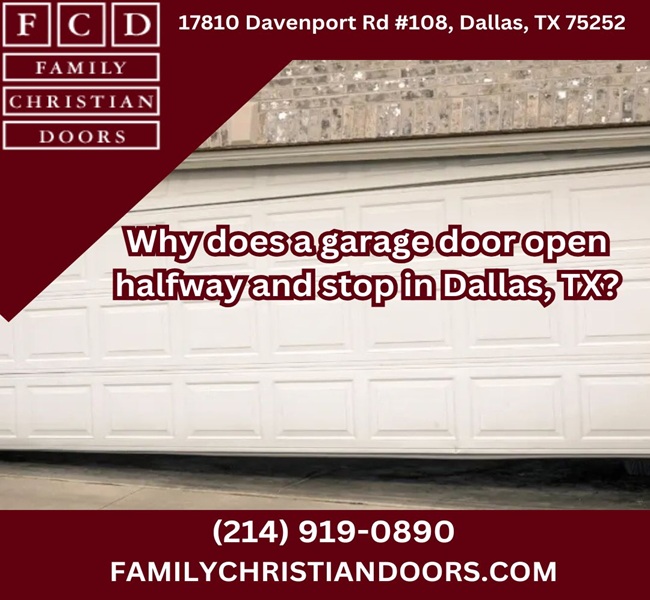
A garage door that opens halfway and stops is almost always a sign of a mechanical failure that needs immediate attention. This frustrating problem typically stems from broken springs, malfunctioning sensors, failing openers, or safety mechanisms activating unexpectedly. For Dallas homeowners, the unique climate creates additional complications. The extreme temperature swings between hot summers and mild winters, combined with high humidity levels, accelerate wear on critical door components and make diagnosis more complex. Understanding what causes this issue and why professional service matters could save you from expensive damage, prevent safety hazards, and restore reliable access to your home. If you’re experiencing this problem, garage door repair services can diagnose and resolve the issue safely.
What It Means When Your Garage Door Gets Stuck Halfway
The Immediate Safety Concern
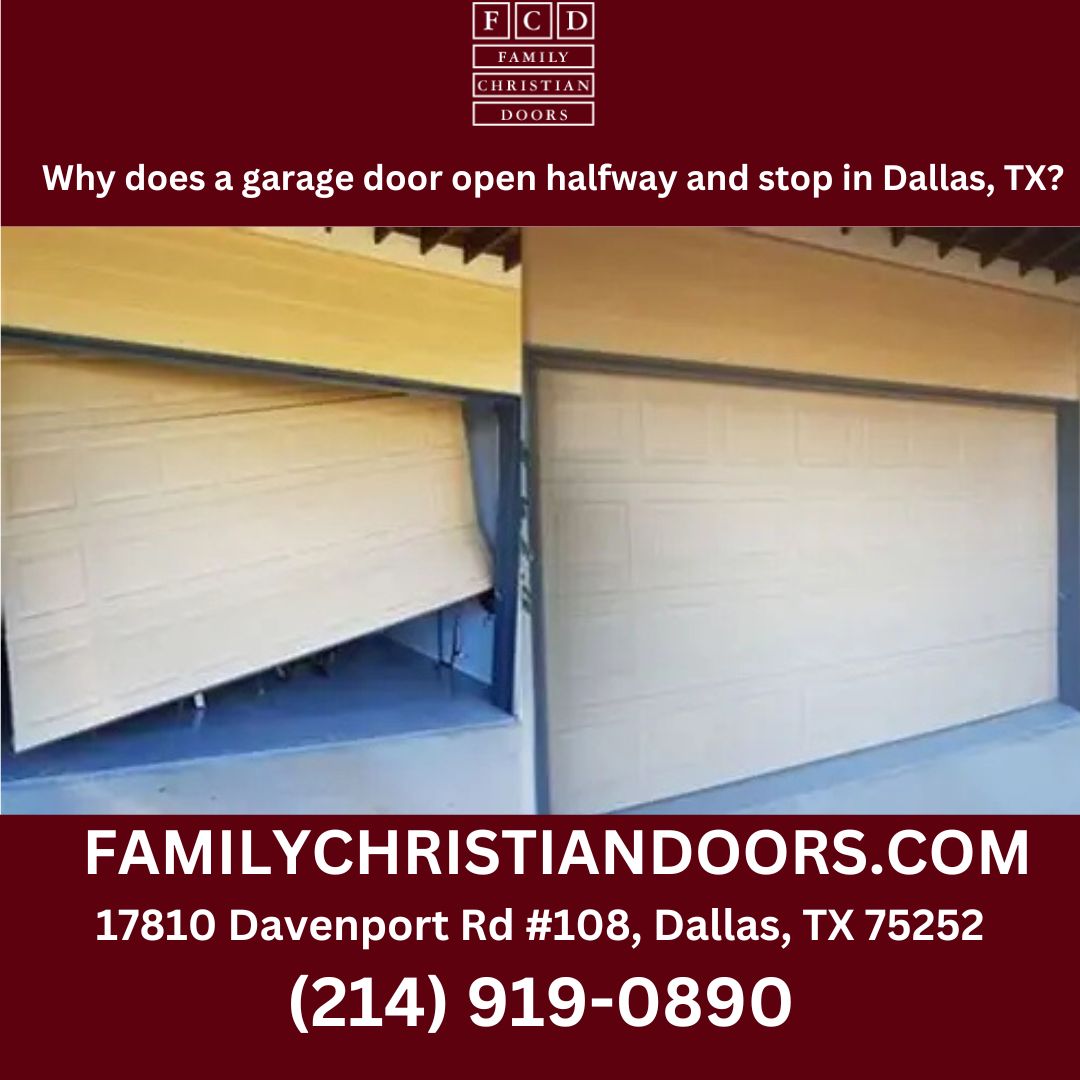
A garage door stuck halfway is not a minor inconvenience. This position creates a significant safety risk. The door weighs several hundred pounds, and if it falls unexpectedly, it can cause serious injury or property damage. The automatic reverse safety system may have activated, which is actually a protective feature, but understanding why it triggered is crucial. Continued attempts to force the door open or closed can damage the mechanism further and create liability issues if someone is injured in the process.
Why This Problem Matters More in Dallas’s Climate
Dallas experiences temperature fluctuations that few homeowners anticipate. Summer highs regularly exceed 95 degrees Fahrenheit, while winter temperatures can drop into the 30s. This 60-plus-degree swing stresses metal components, causes expansion and contraction cycles, and accelerates corrosion. Additionally, Dallas humidity levels increase strain on electronic sensors and motor bearings. What might be a slow wear problem in milder climates becomes an urgent repair need in North Texas.
Six Common Causes of Halfway Stop Problems
1. Broken or Misaligned Springs (Temperature-Sensitive)
Garage door springs are engineered to support the weight of your door. Dallas springs fail faster than those in other regions because constant thermal expansion and contraction weakens the metal. A broken garage door spring is one of the most common reasons doors stop midway.
How Dallas heat cycles stress your springs
Spring tension changes with temperature. On a 100-degree summer day, your spring expands. During a cool morning, it contracts. This constant movement, repeated hundreds of times yearly in Dallas, causes micro-fractures. Eventually, the spring loses its ability to counterbalance the door weight, and the door stops or falls suddenly. You might hear a loud snap before the door gets stuck.
Why this requires immediate professional attention
A broken spring is dangerous to replace without proper tools and training. The tension stored in a spring can cause serious injury. Attempting DIY replacement has hospitalized homeowners. Professional technicians have specialized equipment and understand proper spring sizing for your specific door weight and Dallas climate conditions.
2. Malfunctioning Safety Sensors
Modern garage doors have safety sensors positioned on both sides of the opening at ground level. These sensors detect obstructions and trigger the automatic reverse to prevent the door from closing on a person or object. When they malfunction, the door often stops midway as a safety precaution.
Dust and humidity in Dallas affecting sensor alignment
Dallas humidity promotes dust accumulation and corrosion on sensor lenses. Even a thin layer of dust blocks the infrared beam between sensors. High humidity can cause the sensors themselves to fail internally. When sensors cannot communicate properly, the opener stops the door mid-cycle rather than risk injury. A safety sensor out of adjustment might seem minor, but it triggers the safety reverse and stops your door from operating.
The liability issue of ignoring sensor problems
If your door closes and injures someone while your sensors are broken, you could face significant liability. Insurance claims and medical costs can exceed the cost of professional sensor service. Ignoring this problem is both unsafe and financially risky.
3. Garage Door Opener Motor Failure
The garage door opener motor is an electric motor designed for thousands of cycles. Dallas heat, however, reduces motor lifespan. The motor needs to work harder in high temperatures, and cooling systems struggle to manage the extra load.
Thermal stress from Texas heat on motor components
During Texas summers, opener motors run hotter than in cooler climates. Internal windings break down faster. Capacitors, which store electrical energy needed to start the motor, fail early in hot conditions. When the motor begins to fail, it may open the door partially, then lack the power to continue. You might notice the motor running, but the door moving slowly or stopping.
Recognizing when the opener is dying
Warning signs include grinding noises, the motor running without the door moving, or the door opening only a few feet before stopping. These symptoms indicate the motor is nearing end of life. A garage door opener replacement is usually more practical than repair for openers more than 10 years old in Dallas’s climate.
4. Track Misalignment or Obstruction
Garage door tracks guide the door rollers up and down. If tracks become misaligned or obstructed, the door cannot travel smoothly and may stop partway.
Debris accumulation in humid Dallas conditions
Dallas humidity encourages rust on metal tracks. Rust flakes, accumulated dust, leaves, and debris block the track. Even small obstructions prevent smooth rolling. During summer storms, mud and debris find their way into tracks. The door struggles to move, the opener senses resistance, and stops to avoid damaging itself. When track issues become severe, your door may be garage door off-track and requiring professional realignment.
Why DIY attempts often make this worse
Clearing obvious debris seems straightforward, but misaligned tracks require specialized tools and expertise to fix properly. Attempting to force a misaligned door can bend tracks further, damage rollers, and require expensive repairs. Professional technicians can safely realign tracks and restore smooth operation.
5. Safety Reverse System Activating
The safety reverse system is a required safety feature. If the door encounters unexpected resistance, it stops and reverses direction to prevent injury. This is working as designed, but repeated activation indicates an underlying problem.
Understanding what triggers the auto-reverse
The system activates when the opener senses force greater than normal limits. This could mean a broken spring, track obstruction, roller damage, or sensor malfunction. Each time you press the button again, the system reactivates. The problem grows worse with each attempt.
Why repeated attempts can damage your door
Forcing the door past the safety reverse point overloads the opener motor and can break components. The door mechanism becomes more damaged. What might have been a simple repair becomes an expensive replacement. Stopping after the first failure and calling professionals protects your door and prevents compounding damage.
6. Weather-Related Thermal Expansion
Metal expands when heated and contracts when cooled. Garage doors are made primarily of steel and aluminum, both highly reactive to temperature changes.
How Dallas temperature swings affect door mechanics
A door that opens perfectly fine at 75 degrees may struggle to open at 100 degrees when metal has expanded. Hardware becomes slightly misaligned. Hinges, brackets, and fasteners shift. The cumulative effect of these small changes causes friction that prevents smooth operation. The door may stop midway because the expanded frame creates binding points that the opener cannot overcome.
Seasonal patterns and what to expect
Many Dallas homeowners notice door problems worsen during peak summer heat. As temperatures drop in fall, the problem might seem to resolve temporarily. This is thermal expansion and contraction, not true repair. A professional evaluation identifies whether you have a temporary seasonal issue or a permanent mechanical failure requiring service.
| Problem Type | Dallas Climate Impact |
| Broken Springs | Heat cycles accelerate metal fatigue; failure happens 2-3 years earlier than other regions |
| Sensor Failure | Humidity and dust buildup increases; sensors fail at higher rates in high moisture environments |
| Motor Burnout | Extreme summer heat reduces motor lifespan; cooling systems overwhelmed in Texas temperatures |
| Thermal Expansion | 60 plus degree swings between seasons cause constant mechanical stress and seasonal door problems |
Dallas Heat and Humidity: The Hidden Factor
Why Your Garage Door Is More Vulnerable Here
Homeowners in cooler regions often have garage doors that operate reliably for 15 to 20 years. In Dallas, 10 to 12 years is more realistic, sometimes less. The combined effects of extreme heat, temperature swings, and humidity create an accelerated wear environment. Your door isn’t failing because of poor manufacturing. It’s failing because Dallas’s climate is harder on these mechanical systems than anywhere else in the country.
This isn’t something you can prevent entirely, but understanding it helps you make informed decisions about maintenance and repair timing. Regular professional inspections can catch problems early before they lead to a door stuck halfway.
What You Should (and Shouldn’t) Do First
Safe Diagnostic Steps You Can Take
Before calling for service, perform these safe checks. First, ensure nothing is blocking the track. Look for debris, leaves, or objects in the door’s path. Second, visually inspect the springs. If you see a gap in the spring or a coiled spring that appears separated, a spring is broken. Do not attempt to touch or adjust the spring. Third, clean the sensor lenses with a soft cloth. Dust alone might be the issue. Fourth, listen to the motor. Does it sound normal, or is there grinding or unusual noise? Finally, try opening the door fully using a wall button instead of the remote. If the wall button works but the remote doesn’t, the problem might be related to limited garage door remote range rather than the door itself.
When DIY Troubleshooting Creates Bigger Problems
Stop attempting to force the door open if it stops halfway. Do not repeatedly press the button hoping the door will suddenly respond. Do not attempt to manually lift the door. Do not try to adjust springs, cables, or track alignment yourself. These actions can cause injury or create compound damage that makes repair more expensive. If your diagnostic steps don’t reveal an obvious solution, professional service becomes necessary.
Why Professional Diagnosis Matters More Than You Think
Hidden Safety Risks in DIY Repairs
Garage door systems have multiple points of failure that interact with each other. A broken spring might seem obvious, but it could indicate that rollers have also worn out. A sensor problem might mask a motor that’s beginning to fail. A professional inspection identifies all issues at once, preventing future callbacks and protecting your safety. Many injuries occur when homeowners attempt repairs without understanding the complex interplay of these components.
The True Cost of Delayed Professional Service
Delaying professional service doesn’t save money. It costs more. A broken spring caught early requires spring replacement. If you wait and the door falls, you might damage the door panel, the track, the rollers, and the opener all at once. A sensor that fails early can be replaced individually. If you ignore it, the opener motor overworks and burns out within months. Professional service identifies problems at their least expensive point of repair.
Conclusion
A garage door stuck halfway is your signal that something in the mechanical system has failed. The cause could be broken springs, malfunctioning sensors, motor failure, track misalignment, a triggered safety system, or thermal expansion from Dallas’s extreme climate. Each of these problems requires different solutions, and some are dangerous to address without professional expertise.
Dallas’s climate accelerates garage door aging and makes diagnosis more complex. What appears to be a simple problem often masks multiple issues that a trained technician can identify. Professional service isn’t an expense to avoid. It’s an investment in safety, reliability, and preventing compound damage that turns a manageable repair into an expensive replacement.
If your garage door opens halfway and stops, the safest and most practical choice is to contact Family Christian Doors. Our technicians understand Dallas’s climate challenges and can diagnose your specific problem accurately. Visit our website to learn more about garage door repair services in Dallas and schedule an appointment with professionals who will get your door working safely and reliably.
