

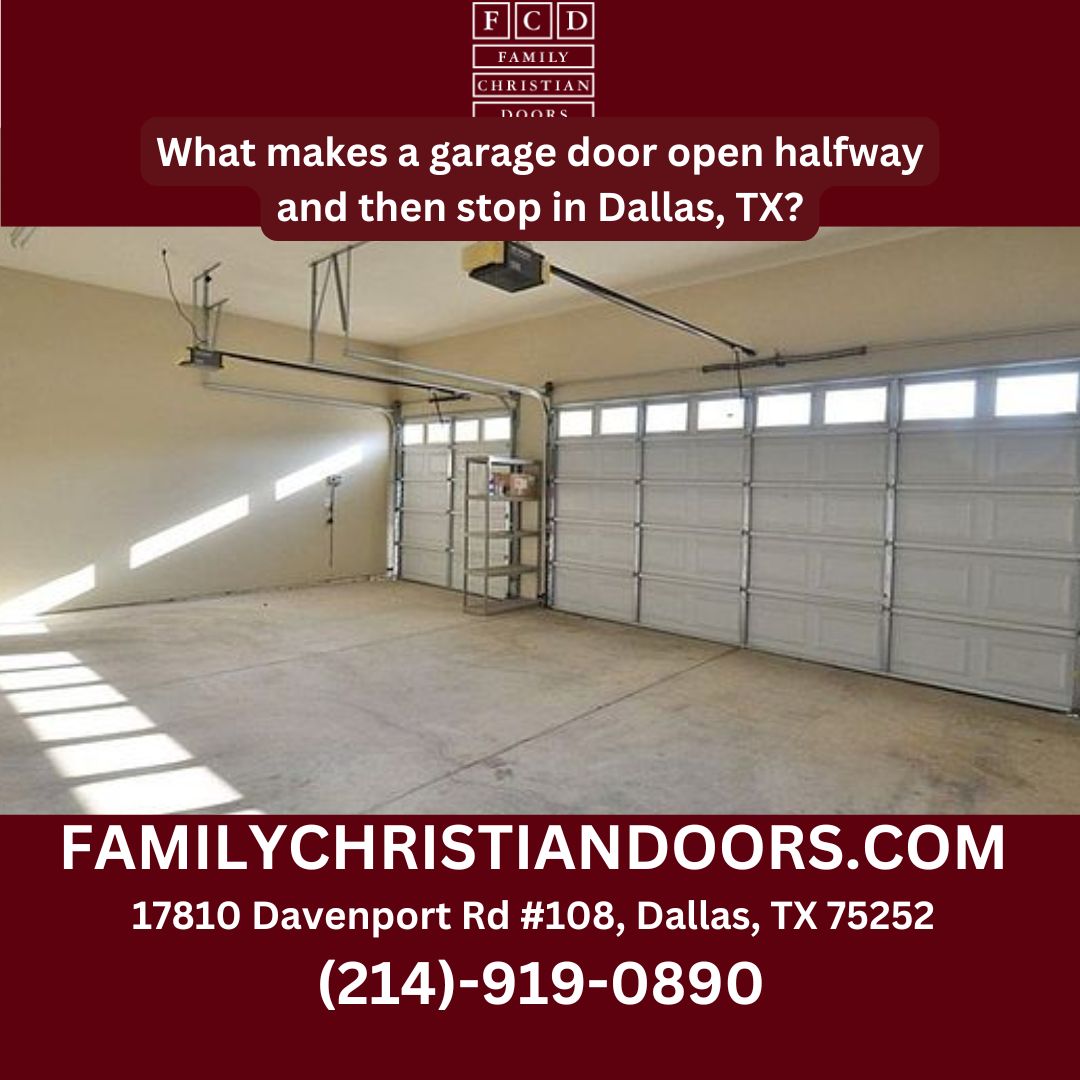
A garage door repair is usually caused by misaligned safety sensors, a struggling torsion spring, or an opener limit setting that no longer matches the door’s actual travel path. In Dallas, these issues often show up more frequently because of how the region’s clay soil and temperature swings affect the door’s tracks and hardware over time. For homeowners, a door that stalls partway is more than an inconvenience. It can signal a mechanical problem that will only get worse, and in some cases it points to a safety issue that should not be ignored. Understanding what is happening behind the scenes helps you decide whether this is something to watch, something to inspect yourself, or something that needs a trained technician right away.

Common Reasons Your Garage Door Stops Midway
Most garage doors are engineered with several interlocking systems working together. When one part falls out of sync, the door often responds by stopping rather than continuing to move, which is actually a built in safety behavior. Here are the most frequent causes homeowners run into.
Misaligned or Obstructed Safety Sensors
Every residential garage door opener manufactured in the last few decades includes photo eye sensors mounted near the bottom of each track. These sensors send an invisible beam across the doorway, and if that beam is broken or the sensors are not pointed at each other correctly, the opener will refuse to complete the cycle. Dust buildup, spider webs, or even a shift of a fraction of an inch can be enough to throw off the alignment, a condition often described as a Safety Sensor Out of Adjustment. Many Dallas homeowners notice this issue more in the fall, when falling leaves and debris settle near the sensor housings.
Broken or Worn Torsion Springs
Torsion springs carry the bulk of the door’s weight and allow the opener motor to lift it smoothly. When a spring weakens or cracks, the opener senses added resistance partway through the lift and stops to avoid straining the motor. This is one of the more serious causes on this list, since a spring under tension can release suddenly and cause injury if handled incorrectly.
Limit Switch Settings Are Off
The limit switch tells the opener how far the door should travel before stopping. If this setting drifts, either from age or a recent adjustment, the opener may think the door has reached its endpoint when it has only gone partway. This is a common issue after a new opener installation or battery replacement, when the settings have not been recalibrated to the specific door.
Track Misalignment or Obstruction
The metal tracks that guide the rollers must stay parallel and free of dents or debris. A bent track, a loose bracket, or something as small as a rock lodged inside can cause the rollers to bind, which stalls the door’s movement and in more severe cases leads to a fully Garage Door Off-Track condition. Homes with driveways that see heavy use, including those in Plano and Richardson, tend to experience more track wear over time from vibration and daily operation.
Worn Rollers or Cables Losing Tension
Rollers and lift cables endure constant friction and stress. As they wear down, they can catch, skip, or lose the tension needed to move the door evenly, and a technician performing Garage Door Roller Repair will often find this to be the root cause. This often shows up as a jerky motion before the door stops completely, which is a useful early warning sign.
How Dallas Weather and Climate Affect Garage Door Performance
Local climate plays a bigger role in garage door function than most homeowners realize. The systems below are built to standard specifications, but Texas conditions place extra demands on them.
Clay Soil Shifting and Track Alignment
Much of the Dallas Fort Worth area, including neighborhoods like Garland, Mesquite, and Carrollton, sits on expansive clay soil that swells when wet and contracts during dry periods. This constant movement can shift a garage’s foundation slightly over time, which throws off the alignment of tracks that are bolted to the frame. A door that worked perfectly a year ago may develop a stopping issue simply because the structure around it has moved.
Heat Cycling and Metal Component Expansion
Texas summers push metal components through repeated cycles of expansion and contraction. Tracks, brackets, and springs that heat up during the day and cool overnight are subject to more wear than in milder climates. Over several summers, this cycling can loosen hardware or slightly warp tracks in ways that are not always visible without a close inspection.
Humidity’s Effect on Springs and Lubrication
Humidity swings common in Lewisville, Cedar Hill, and other parts of North Texas can accelerate corrosion on unprotected springs and dry out lubrication faster than expected. A spring that looks fine on the surface may already be weakened underneath, which contributes to the stalling behavior described earlier.
How to Diagnose the Problem Before Calling a Professional
A short visual check can often narrow down whether the issue is mechanical or electrical before a technician arrives.
Quick Visual Inspection Checklist
- Check that both sensor lights near the floor are solid, not blinking
- Look for visible gaps, bends, or debris in the tracks
- Watch for uneven movement or jerking as the door travels
- Inspect the springs above the door for visible gaps or rust
- Note whether the stopping point is consistent or changes each time
When the Issue Points to Electrical vs. Mechanical Failure
If the door stops at the same point every time and the sensor lights are steady, the issue is more likely mechanical, such as a spring or track problem. If the stopping point changes or the sensor lights are flickering, the cause is more likely electrical or sensor related. This distinction helps a technician arrive prepared with the right diagnostic approach.
Garage Door Symptom and Likely Cause Comparison
| Symptom | Likely Cause |
| Door stops at the same spot every time | Limit switch setting or track obstruction |
| Sensor lights blinking or unlit | Misaligned or dirty photo eye sensors |
| Door moves unevenly or jerks before stopping | Worn rollers or loose cables |
| Door feels heavy or opener strains audibly | Weak or broken torsion spring |
| Stopping point changes each time it is used | Electrical or opener control board issue |
Why This Isn’t a DIY Fix in Most Cases
While a quick sensor cleaning is safe for most homeowners, several of the causes above are not suited for do it yourself repair.
Spring Tension Risks
Torsion springs are wound under significant tension to support the weight of the door. Attempting to adjust or replace one without the correct tools and training can cause sudden, forceful release that leads to serious injury, which is why a Broken Garage Door Spring should always be handled by a trained technician. This is one of the few home repairs where professional experience genuinely protects your safety.
Sensor Recalibration Complexity
Realigning sensors sounds simple, but getting the beam path, mounting angle, and wiring connections correct requires patience and the right diagnostic approach. A technician can identify whether the root issue is the sensor itself, the wiring, or the opener’s control board, which prevents repeat visits for the same underlying problem.
Frequently Asked Questions
Why does my garage door reverse before it fully opens?
This usually happens when the opener detects resistance, whether from a misaligned track, a weak spring, or a sensor obstruction, and reverses as a built in safety response rather than forcing the motor to continue.
Can a garage door opener cause it to stop halfway?
Yes. Opener issues, including worn gears, control board errors, or incorrect limit settings, can cause the door to stop before reaching full open, even when the door hardware itself is in good condition.
How much does it cost to fix a garage door that won’t open all the way?
Cost depends on the specific cause, since a sensor adjustment involves a very different scope of work than a spring replacement. A trained technician can provide an accurate assessment once the root cause has been identified.
Is a garage door that stops halfway a safety hazard?
It can be, particularly if the cause involves a weakened spring or a door that could fall unexpectedly. Treating a partial opening as an early warning sign rather than a minor annoyance is the safer approach.
Conclusion
A garage door that opens halfway and then stops is rarely a random glitch. It is typically the result of sensor misalignment, spring wear, track issues, or opener settings that no longer match the door’s condition, and Dallas homeowners face additional wear from clay soil movement, heat cycling, and humidity. Paying attention to when and how the door stalls can help identify the cause before it becomes a bigger repair. For homeowners across Dallas who want a clear, accurate diagnosis, Family Christian Doors offers experienced garage door repair service built around identifying the real issue the first time. Reaching out for a professional evaluation is the most reliable way to restore full, safe function to your garage door.